

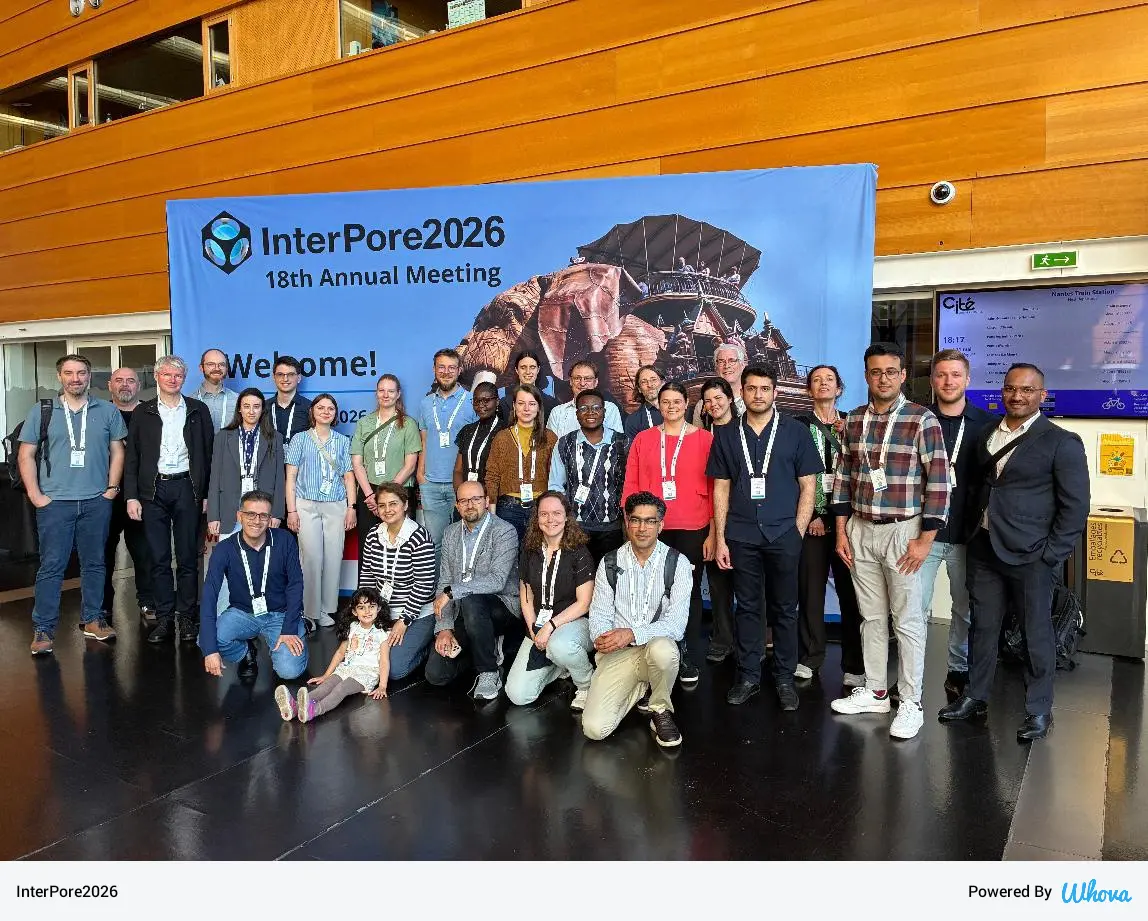
In May, the 18th Interpore Conference took place in Nantes, France. Prof. Dr. Nadja Ray (Chair of Geomatics and Geomathematics at MIDS) attended on behalf of KU. In addition to participating in the conference, Prof. Ray also organized a mini-symposium and two poster presentations. The steering committee of the German chapter also met, and there were many opportunities for professional exchange.
(MS07) Mathematical and numerical methods for multi-scale multi-physics, nonlinear coupled processes
Lead Organizer: Nadja Ray - Katholische Universität Eichstätt-Ingolstadt (KU), Germany
- Tuanny Cajuhi - Federal Institute for Geosciences and Natural Resources (BGR), Germany
- Mostafa Mollaali - Helmholtz Center for Environmental Research (UFZ), Germany
- Keita Yoshioka - Technical University of Leoben, Austria
- Advanced mathematical models and analyses of nonlinear coupled equations, sharp interface as well as phase field formulations
- Multiscale and model order reduction techniques (e.g., homogenization, upscaling)
- Novel discretization schemes and solvers to improve accuracy and computational efficiency
- Robust nonlinear and linear solution strategies
- Integration of experimental data and application of AI and machine learning tools
- Marcio Murad - National Laboratory for Scientific Computation (LNCC), Brazil
Discontinuous Galerkin Method for Flow in Enlarged Fractured Carbonates - Son-Young Yi - The University of Texas at El Paso, USA
Physics-preserving enriched Galerkin method for a fully-coupled thermo-poroelasticity model
Processes in porous media — including flow, transport, deformation, and reactions — are central to applications in energy, environment, and advanced materials. Experiments and field observations are often costly or infeasible, making mathematical modeling and simulation essential.
Challenges arise from strong heterogeneity, multiscale and multiphysics interactions, or phase transitions. This minisymposium invites contributions on:
The minisymposium aims to foster exchange on methodologies and applications for porous media in the geosciences at both laboratory and field scales, as well as on bridging across scales.
Solicited Speaker:
- Marcio Murad - National Laboratory for Scientific Computation (LNCC), Brazil
Discontinuous Galerkin Method for Flow in Enlarged Fractured Carbonates- Son-Young Yi - The University of Texas at El Paso, USA
Physics-preserving enriched Galerkin method for a fully-coupled thermo-poroelasticity model
- Son-Young Yi - The University of Texas at El Paso, USA