[Translate to Englisch:] MIDS Logo

Welcome to the page of the Professorship for Data Assimilation

In order to be able to predict severe weather events or the melting of ice in the Arctic, information in the form of heterogeneous data must be linked with numerical models of dynamic systems. This is done through data assimilation, which makes it possible to better investigate processes and predict their further development.  In the field of data assimilation, the professorship is concerned with the further development of data science algorithms by incorporating physical conservation laws, and solving correspondingly large optimisation problems in the environmental sciences. Quantifying the uncertainties of predictions, numerical models and observations also plays a central role here.

About us

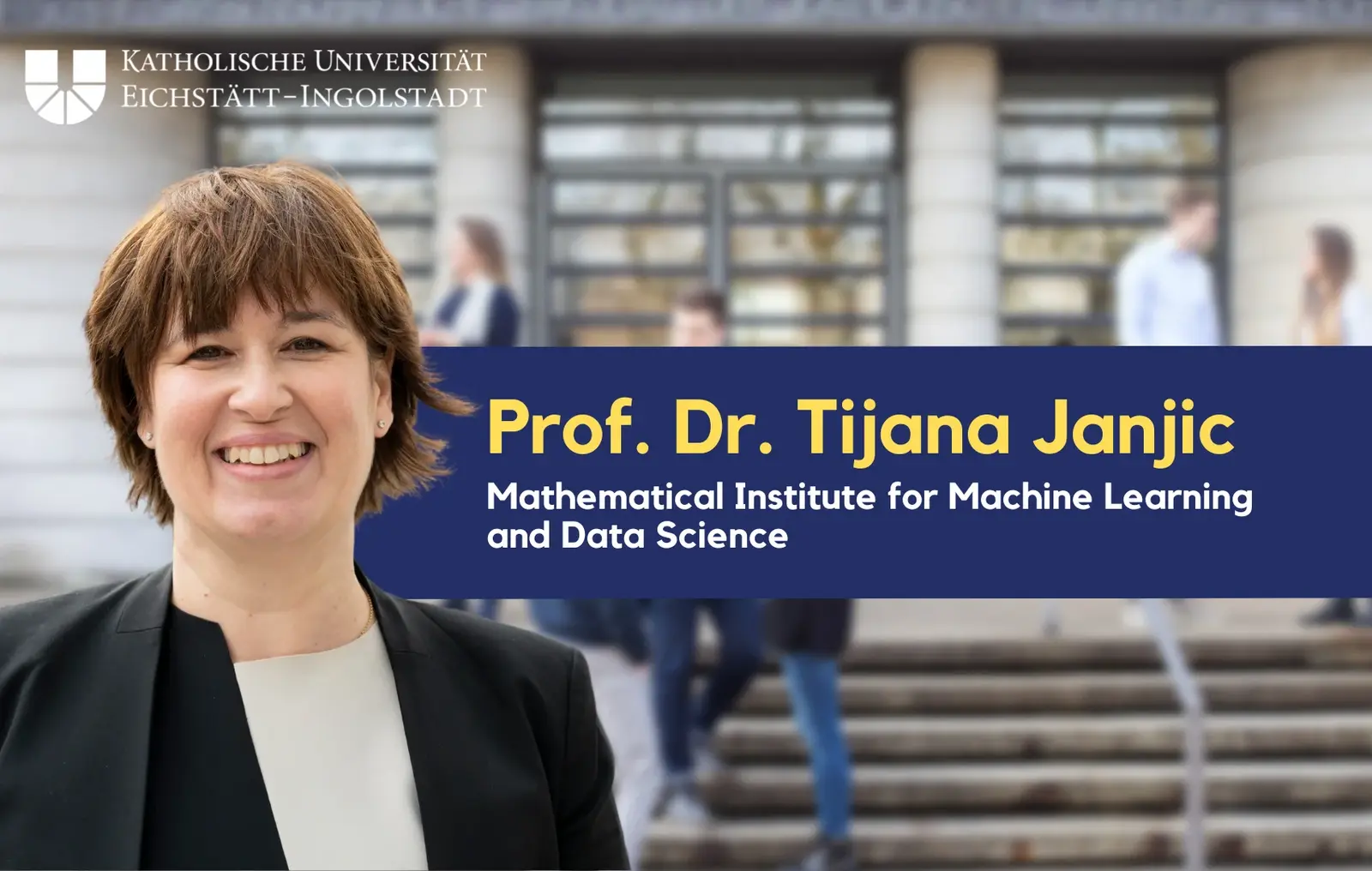
Prof. Janjic introduces herself and the chair

Vorschaubild Youtube Tijana

Please note: By clicking on the image area, you give your consent for video content to be reloaded from YouTube, for YouTube/Google cookies to be stored on your IT system and for personal data such as your IP address to be passed on to Google. If you click on another video after having finished watching the video content, YouTube will open in a new tab of your browser and will collect more data from you. Further information is provided in our data protection notice and under Google Privacy .

Math News

MAS-TOB at the BMFTR Status Meeting “Mathematics for Innovation”

On October 1–2, 2026, the status meeting “Mathematics for Innovation” took place at the Federal Ministry of Research, Technology and Space (BMFTR) in Bonn. Among the projects represented was “MAS-TOB: Multiscale Analysis and Structural Optimization of Patient-Specific Therapeutic Orthoses and Bandages,” which started earlier this year and is funded for a period of three years.


The project team from the three participating institutions (Fraunhofer ITWM Kaiserslautern, RPTU Kaiserslautern-Landau, and KU Eichstätt-Ingolstadt) was represented by Anna Simon and Prof. Dr. Carolin Kreisbeck from the Chair of Analysis at KU, as well as Dr. Julia Orlik from Fraunhofer ITWM. Anna Simon presented MAS-TOB as part of the short presentation sessions. The subsequent poster session provided further opportunities for stimulating discussions and scientific exchange.

A central goal of MAS-TOB is to develop a methodology and, building on this, a software solution in the form of a digital twin that can predict how different knitted fabrics need to be printed to achieve targeted local stiffening and restrictions of movement. The project team works closely with the industry partner Sporlastic in this context.

A distinctive feature of the collaborative project is its interdisciplinary approach, bringing together different areas of mathematics and connecting them closely with applications: 

from modeling and analysis through optimization, numerical methods, and simulation to their implementation in patient-specific products. 

Mathematical Institute for Machine Learning and Data Science

[Translate to Englisch:] Logo MIDS

The Heisenberg professorship is part of the Mathematical Institute for Machine Learning and Data Science, MIDS.
Learn more about MIDS here.