Welcome to the page of the Chair of Mathematics - Scientific Computing
The Scientific Computing group works on the development and analysis of methods in data science, in particular those based on applied harmonic analysis and functional analysis. Focus topics include signal processing, information theory, sampling theory, time-frequency analysis, quantization and machine learning.
For example, our group develops efficient methods to assemble (synthesize) from or decompose (analyse) functions or operators into well-understood basic building blocks. Analysis relies on the understanding of appropriately chosen basic components and on determining the weight of each component in a given signal. For example, a picture can be decomposed into patches of red, green, and blue of varying intensities. The dual operation is signal synthesis. Using the same building blocks as in the analysis step, we can assemble or reassemble (after transmitting and/or modifying coefficients) signals and transformations to our liking. Returning to our example, we could, starting from scratch, draw a picture by choosing patches of red, green, and blue and intensities freely.
In digital communications, synthesis and analysis are applied in succession. To transmit digital data through a medium, an analog signal is formed using a synthesis step. Here, the digital information is embedded in the weights. The receiver then performs an analysis of the obtained signal to extract the weights and with it the digital data. The principal objective is to design building blocks that are robust against disturbances present in transmission channels.
Within the past decade, mathematical contributions to these objectives had an tremendous impact on signal processing and communications engineering: wavelet bases were designed to analyze images (jpeg2000), and Gabor systems are currently used to transmit data through wired or wireless channels (OFDM). A wavelet basis consists of functions, which are all equal in shape but which are translated (shifted in time or space) or stretched copies of each other. The building blocks in Gabor theory on the other hand are functions, which are modulated (frequency-shifted) and translated (shifted in time or space) copies of each other. In recent years, our research within the framework described above focused on time--frequency analysis of operators and Gabor analysis, and their applications in communications engineering. (For educational material, visit the website of the Summer Academy of the Jacobs University Bremen: Progress in Mathematics for Communication Systems.)
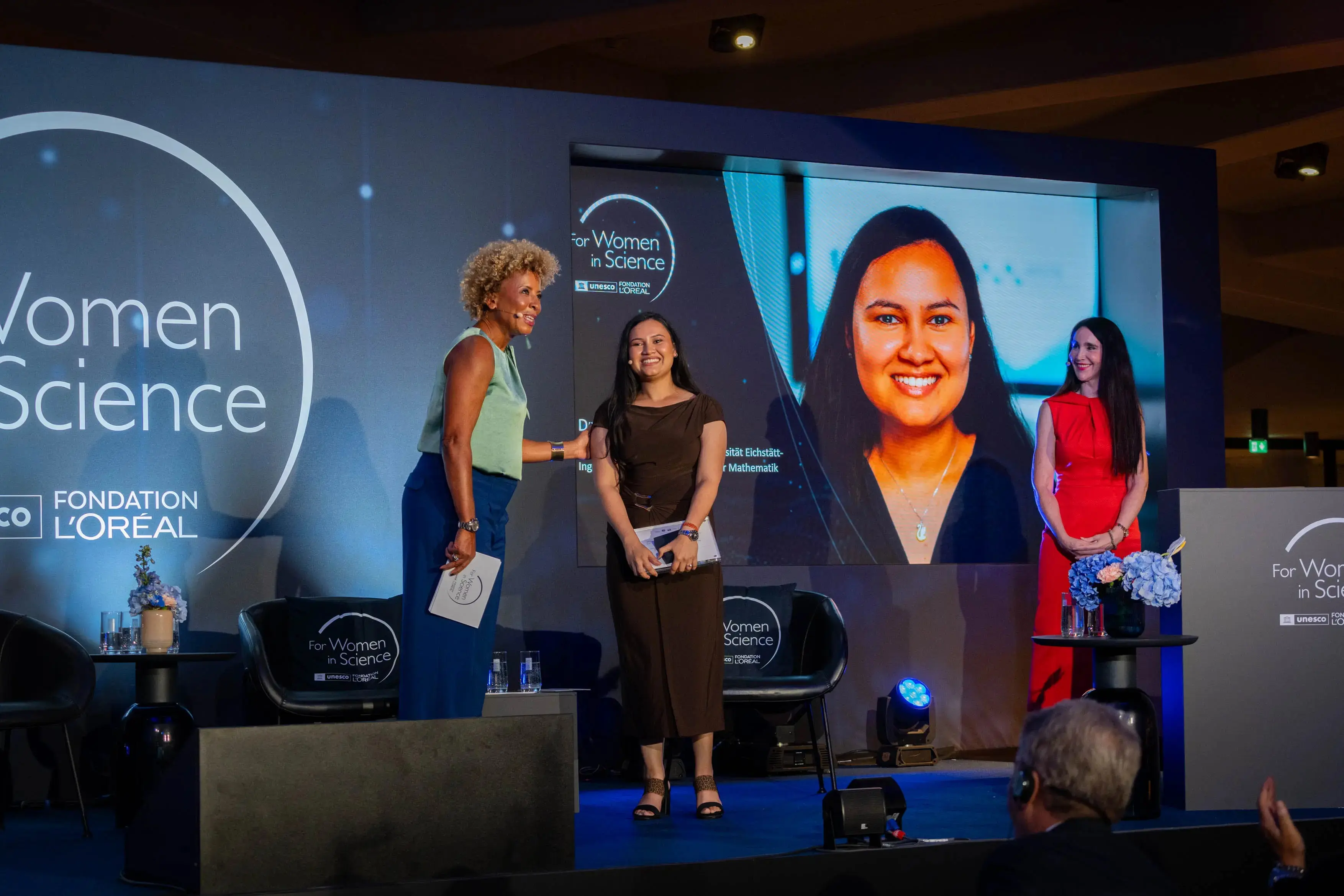
Dr. Mansi Singh (Chair of Applied Mathematics) has won the 2026 For Women in Science Award. The prize, worth €25,000 and sponsored by L’Oréal, UNESCO, and the German Humboldt Network, was presented on September 16 in Düsseldorf.
Dr. Mansi Singh, who works at MIDS, was selected as one of four female scientists for her research on developing new methods to significantly speed up ocean and climate dynamics analyses and simulations while preserving accuracy.
You can view all the award winners, along with a short introductory video for each, on the L'Oréal website.
The award ceremony, hosted by Arabella Kiesbauer, was held under the motto “The world needs science—and science needs women.”
The MIDS team extends its congratulations on this wonderful honor.
Mathematical Institute for Machine Learning and Data Science
The Chair of Scientific Computing is part of the new founded Mathematical Institute for Machine Learning and Data Science, MIDS. Learn more about MIDS here.



![[Translate to Englisch:] MIDS Logo](/fileadmin/_processed_/0/8/csm_ku-mids_i_wm_RGB_5da8d3b4bc.webp)