


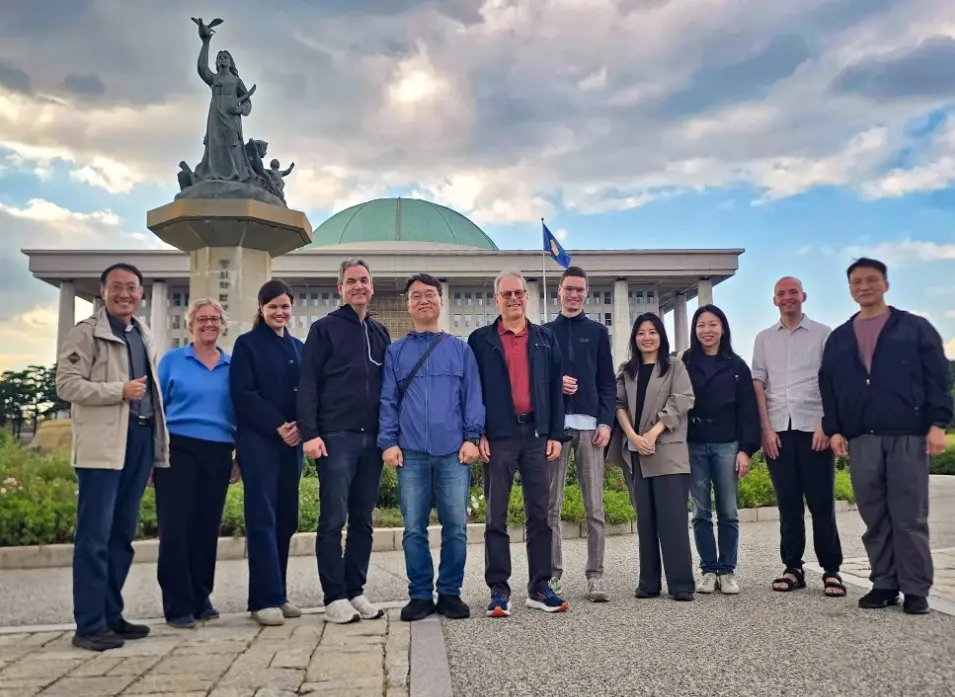
How resilient are democracies in an age of political polarization, declining trust, and social media? This question was at the heart of a visit to Seoul by a delegation from the Catholic University of Eichstätt-Ingolstadt (KU) in early October. At the 15th German–Korean Colloquium, scholars from KU and Sogang University came together to explore the challenges facing democracy and peace. The conference marked another chapter in a decades-long academic partnership and one of KU’s most enduring international collaborations.
Held at Sogang University from October 5 to 8, the colloquium brought together researchers from Germany and South Korea to examine some of the most pressing challenges facing democratic societies today: growing polarization, declining public trust in institutions, and the changing nature of political communication in the age of social media. These issues carry particular significance in South Korea, where debates about democracy, peace, and security remain closely intertwined with the continuing division of the Korean Peninsula. “Looking at different political and social experiences side by side reminds us that democracy can never be taken for granted. It depends on dialogue, critical reflection, and a shared sense of responsibility,” says Prof. Dr. Klaus Stüwe, KU’s Vice President for International Affairs and Profile Development. “For many years, the German–Korean Colloquium has provided an exceptionally valuable forum for precisely this kind of exchange.”
The themes of the conference came into sharp focus at the very beginning of the visit, when participants took part in an excursion to the Demilitarized Zone (DMZ) separating North and South Korea. The academic program that followed at Sogang University brought together perspectives from political science, history, theology, sociology, law, and literary studies. Panel discussions explored democracy and peace, social polarization, religion, and the role of social media in political communication. One of the colloquium’s distinctive features is its emphasis on genuine dialogue between German and Korean scholars: every presentation is followed by a response from a researcher representing the other country, opening the floor to further discussion and debate.
The German–Korean Colloquia have a long history, with roots stretching back to the 1990s. Since 2007, KU and Sogang University have organized the conferences every two years, alternating between Eichstätt and Seoul. KU has played a central role in shaping this tradition, drawing on its interdisciplinary strengths in the humanities, cultural studies, and social sciences. The partnership has become an important part of the university’s international academic engagement. The next German–Korean Colloquium is scheduled to take place in Eichstätt in 2028.
The conference series is coordinated by Prof. Dr. Klaus Stüwe on the German side and Prof. Dr. Seil Oh, Vice President for International Affairs at Sogang University, on the Korean side. Alongside Stüwe, this year’s KU delegation included Prof. Dr. Vanessa Conze, Prof. Dr. Ulrich Kropač, PD Dr. Dr. habil. Mariusz Chrostowski, Dr. Sebastian Egelhof, and Laura Gabler. The colloquium received support from the Maximilian Bickhoff Foundation, KU’s Faculty of History and Social Sciences, Hofmühl Brewery, and the Eichstätt University Society.
Beyond the conferences themselves, the longstanding partnership regularly gives rise to joint academic publications. The latest example is the recently published open-access volume Populism and Post-Truth: Interdisciplinary Perspectives from South Korea and Germany, edited by Klaus Stüwe and Laura Gabler. Bringing together contributions from the 2024 German–Korean Colloquium in Eichstätt, the book examines the implications for democratic societies when facts increasingly lose their influence in political discourse. Drawing on a range of academic disciplines, it offers insights into the challenges posed by populism and the growing significance of post-truth politics.
Text: Laura Gabler


