


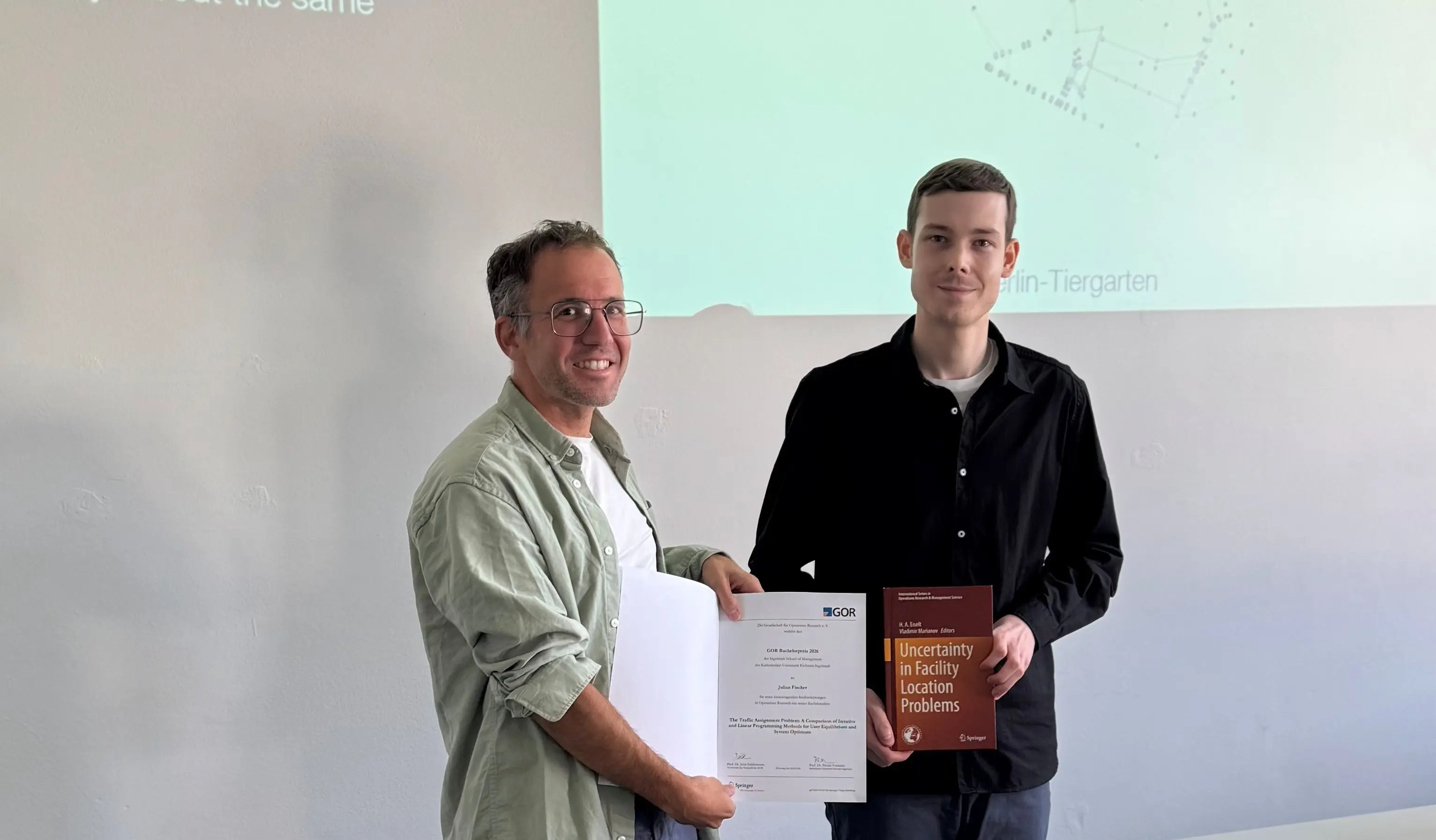
Recognition for an outstanding bachelor's thesis in Operations Research: Julian Fischer receives the GOR Bachelor Award for his research on traffic flow optimization and continues his academic journey in the Master's program in Business Analytics & Operations Research at WFI.
Julian Fischer has been awarded the GOR Bachelor Award 2026. The German Operations Research Society (Gesellschaft für Operations Research e. V., GOR) presents the award to students who have demonstrated outstanding academic achievements in the field of Operations Research.
In his bachelor's thesis, entitled “The Traffic Assignment Problem: A Comparison of Iterative and Linear Programming Methods for User Equilibrium and System Optimum,” Fischer explored the mathematical modeling and optimization of traffic flows. His thesis was supervised by Dennis John at the Chair of Logistics & Operations Analytics, headed by Professor Fontaine.
How Individual Decisions Affect Traffic Flow
A key challenge in traffic planning is understanding how people move through transport networks and how their individual decisions affect overall traffic flow. The route that is best for an individual commuter does not necessarily lead to the best outcome for the entire transport network.
A well-known example of this phenomenon is the so-called Braess's Paradox. It describes the surprising situation in which adding a new road can actually worsen traffic conditions rather than improve them.
An illustrative example occurred in Stuttgart in the late 1960s. An expansion of the road network around Schlossplatz was intended to improve traffic flow but unexpectedly resulted in more congestion. Traffic conditions only improved after a section of the road was closed to motor vehicles.
Mathematical Methods for Optimizing Transport Networks
Julian Fischer's bachelor's thesis addresses precisely these kinds of challenges. He investigated and compared different mathematical solution methods for calculating traffic flows. His research focused on iterative methods and linear programming approaches to determine different traffic equilibria and optimal states within transport networks.
His work contributes to a better understanding of complex mobility systems and demonstrates the importance of mathematical optimization methods in planning and designing efficient transport networks.
Operations Research as a Foundation for Better Mobility Systems
At the Chair of Logistics & Operations Analytics, research focuses on the mathematical modeling and optimization of various mobility and logistics systems. The aim is to better understand complex relationships and use quantitative methods to support well-informed decisions.
“Anyone seeking to improve mobility systems must first understand how people choose their routes and how these individual decisions affect the transport network as a whole. This is precisely the question Julian Fischer investigates using methods from Operations Research. I am very pleased with his outstanding academic achievements and delighted that he will continue his academic journey in the Master's program in Business Analytics & Operations Research at WFI,” says Professor Fontaine.
Julian Fischer will continue his studies in the Master's program in Business Analytics & Operations Research (BAOR) at WFI.
WFI warmly congratulates Julian Fischer on receiving the GOR Bachelor Award 2026 and wishes him continued success in his academic career!


