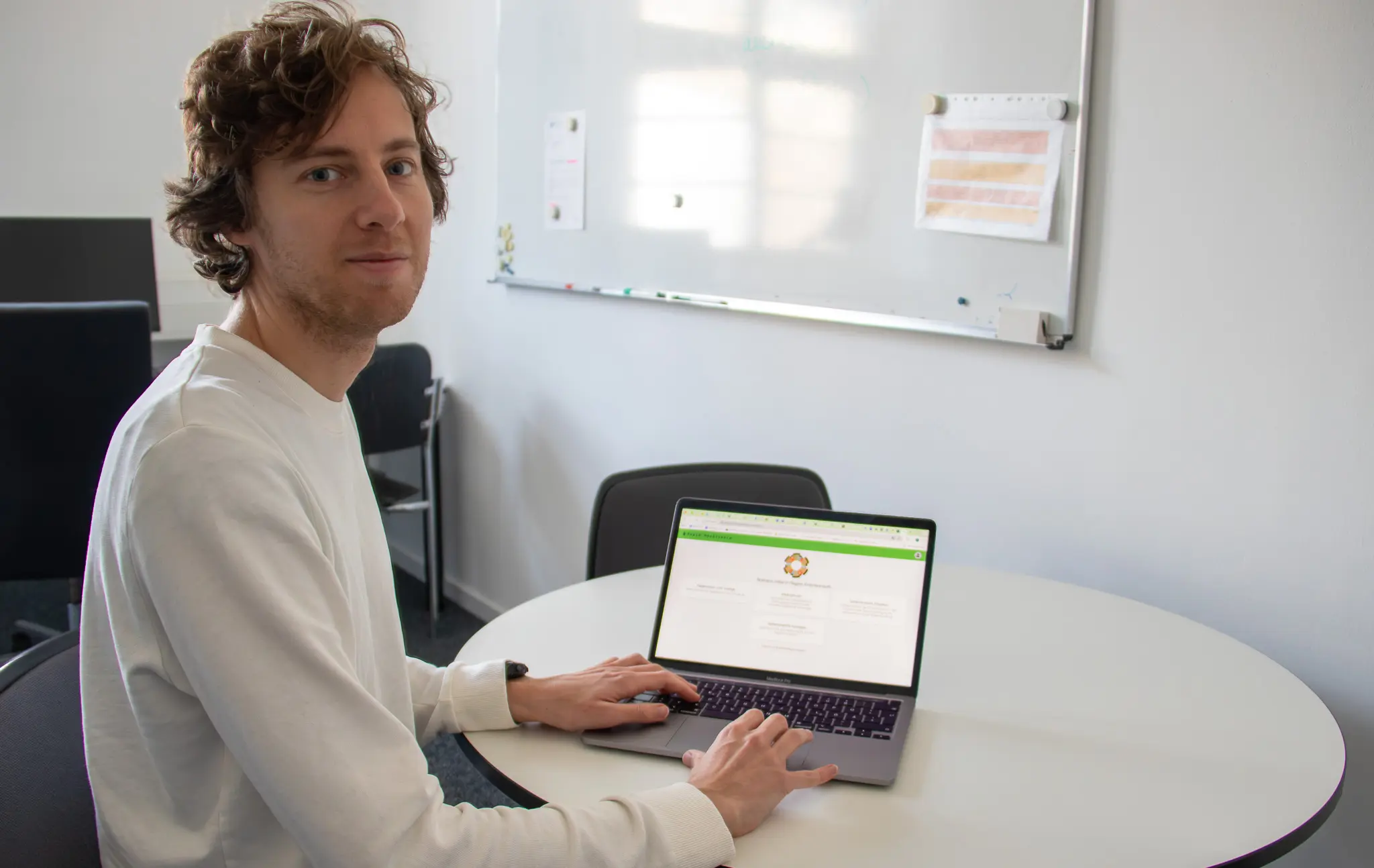
“Heavy rainfall is a huge challenge that overwhelms local authorities. It is a local event that can affect all municipalities—even those that are not located near water”, explains Boeckmann, who is the acting professor of Statistics and Quantitative Methods in Economics at the KU. This definition distinguishes heavy rain from flooding, which refers to rising river levels.
To enable local authorities to predict which buildings are particularly at risk from heavy rainfall, he has developed special software together with his doctoral supervisor, Professor Thielen: “Building protection means protecting humans. Because people stay in buildings during heavy rainfall.”
The software developed by the two researchers makes it possible to create so-called hazard maps for freely selected areas. Users mark the area to be analyzed on a map and can specify whether they want to determine the flood risk for the buildings or also the flow directions and velocities of the water. After just a few hours, the program produces a map that uses a color system to indicate the risk potential for the individual buildings.
“There has never been a system like this on the market before. Until now, there were only classic geoinformation systems or various simulation software programs with long runtimes that are so complicated that municipalities cannot control them themselves”, explains Boeckmann. With his software, however, municipalities can not only analyze heavy rain hazards cost-effectively, but also test various solution measures in theory. To do this, they add a retention basin, for example, and recalculate how the water will behave during heavy rainfall.
The software has “an effect for the whole of Germany”, says Boeckmann: "It is not limited to a specific location. We have very good data for the whole of Germany and exceptionally good data for Bavaria. Here, drones are used to measure how high each square meter is above sea level, giving us a digital terrain model.“ The software obtains building data from Open Street Maps. ”This is community-based and therefore does not incur any license fees. However, data from the German Weather Service is also important to us."
In April 2021, the research team was able to present a first usable version of the software. Due to the flood disaster in the Ahr Valley in July 2021, the issue of heavy rainfall then became more prominent in public discourse. “We had many interviews that made our software better known. A major breakthrough for us was when Johannes Becher, a member of the state parliament, connected us with many municipalities.” According to Boeckmann, 76 municipalities have now used their tool, and 36 have even created an entire heavy rainfall concept based on the software.
Boeckmann is now pursuing the goal of commercializing the software in such a way that it finances itself: in order to be able to continuously update the program and develop security updates, for example, he needs permanent, project-independent funding. “I want to expand the project. I have realized that I have a role to play in this and can make a difference personally.” That is why receiving the Bavarian Climate Protection Award is such a valuable honor for him: it raises awareness of the project and thus draws the attention of even more municipalities to this effective way of protecting against heavy rainfall.