Sustainability while studying abroad

Why sustainability is important when studying abroad
A semester abroad is a special opportunity—not only to get to know new cultures and gain academic experience.
It is also an opportunity to take responsibility, because how we travel, live, consume, and organize our everyday lives has a direct impact on the environment, society, and local structures.
This page offers information, suggestions, and practical tips on how you can make your stay abroad more sustainable.
Guide: Sustainable Study Abroad
Our guide shows you specific ways in which you can act responsibly abroad—whether it's traveling, finding accommodation, consuming, or getting involved in local social activities. After all, sustainability starts with small everyday decisions: How do we travel? How do we live? How do we shape our student life in our new environment?
The content is based on the United Nations' 17 Sustainable Development Goals (SDGs). It offers suggestions on how you can contribute to a fairer and more environmentally friendly world with simple means – without losing sight of your everyday student life.
Download: Guide: Sustainable Study Abroad
Sustainable partner universities: Interactive overview
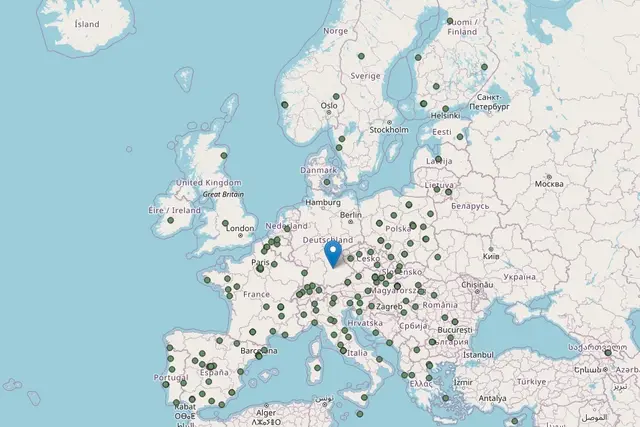
Many of our partner universities are actively committed to sustainability—through green campus initiatives, environmental projects, research, or student engagement, for example. Our interactive map provides you with an overview of good examples worldwide—compact, visual, and easily accessible.
How to use the map:
- Explore the map: Click on a marker or hover over it with your mouse to learn more.
- Show public transportation: Click on “Public Transportation” (instead of “OSM Standard”) in the upper right corner to display bus and train lines in cities.
Note on the ranking: A low sustainability score does not automatically mean that a university is performing poorly—many institutions are still in the early stages or have different priorities.
Sustainability on Instagram: The “Sustainable Abroad” series
In the summer semester of 2026, we will be posting a series of short, practical tips on our Instagram channel (@IO_KU) covering sustainable mobility, living, consumption, and social engagement during a semester abroad. You are welcome to participate or contribute your own experiences.
Instagram: instagram.com/io_ku
Green Travel Options
Bus
The long-distance bus network in Europe is extensive and connects numerous cities and countries. It offers a cost-effective and environmentally friendly travel option that is a flexible alternative to other modes of transport.
Some options for long-distance bus companies:
- Flixbus is probably the best-connected and most widespread long-distance bus company in all of Europe.
- Regiojet is another option for destinations in Central Europe.
- Eurolines is particularly relevant for trips to Eastern Europe.
- Lasta offers many long-distance bus options in the Balkan region.
- ALSA is a provider with a focus on Southern Europe.
- BlaBlaBus is one of the most important long-distance bus companies, especially in Western Europe.
Train
Traveling by train is considered one of the most sustainable mobility options, as trains produce significantly less CO₂ emissions than planes and cars. In Europe in particular, the extensive rail networks offer an environmentally friendly way to travel quickly and comfortably between countries.
- Erasmus+ Interrail: offer for train travel throughout Europe and neighboring countries.
- Night trains throughout Europe and neighboring countries.
- DB and SNCF for travel throughout Europe.
- DB und ÖBB are the best providers in Central Europe.
- SNCF and Eurostar for Western Europe.
- PKP Intercity and ČD are the strongest providers in Eastern Europe.
Carpooling
Carpooling contributes to green travel because it reduces CO2 emissions per person by allowing several people to share a vehicle, thereby reducing the number of vehicles on the road. This reduction in traffic volume leads to lower emissions and less environmental impact.
- BlaBlaCar is the largest carpooling service in Europe.
- By contacting other Erasmus+ participants at your home and host university, it is often possible to form carpools.
Important:
- What qualifies as a carpool? A carpool is defined as at least two people traveling together in a private car. Multiple Erasmus+ participants receiving funding can form a carpool and apply for the Green Travel grant.
Good to know: Trips organized through carpooling platforms also count as Green Travel – a corresponding proof must be submitted. - Important: Trips with family members or other non-students do not count as eligible carpools – unless you can prove that these individuals were also staying at the destination for a longer period, e.g. for study or work.
Additional resources
Planning a trip for mobility can be challenging, as various transportation options and connections must be taken into account. The following websites can help you find the right “green travel” option for you:
The ISIC and ESN cards offer various discounts and benefits for students, especially in the area of mobility.
If flying is the only option, many online booking platforms allow you to sort flights by the lowest CO2 emissions. However, regardless of CO2 savings, flying does not fall under the term “green travel.”
Five tips for a sustainable start to your semester abroad

- If possible, use the train or long-distance bus to travel to your destination, or offset your flights.
- Use reusable water bottles and shopping bags.
- Buy second-hand—it's often cheaper and more resource-efficient.
- Find out about local food sharing or fair sharing initiatives.
- Get involved locally, for example in environmental projects or social organizations.
Background: The “Senatra” project
The guide and accompanying materials were developed as part of the service learning seminar “Sustainable Abroad,” which is part of the Germany-wide university project “Senatra – Service Learning and Sustainable Transformation at Universities.” The aim of the project is to empower students to make an active contribution to sustainable university development – in teaching, campus life, and international activities.
Further information on the project can be found at
Contact person
If you have any questions or would like to contribute your own ideas on the topic of “sustainability while studying abroad,” please contact the International Office:

Stephany
Koujou
Outgoing Students Coordinator
Building
Domplatz 8
|
Room: DP8-201 | Campus Eichstätt