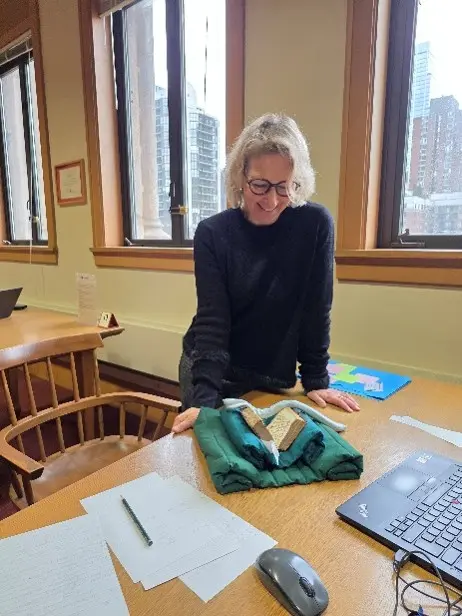
What began as doctoral work with a professor she admired gradually turned into a lifelong academic path. Along the way, she discovered her love for manuscripts and for the religious literature of the Middle Ages, especially books written in German by religious and monastic women.
Originally from northern Germany, Emmelius studied at the University of Göttingen before moving through several major academic institutions in Germany. She held an assistant professorship in Düsseldorf, spent time in Berlin at both Humboldt University and Freie Universität, and finally became Chair of Medieval German Language and Literature and Director of the Research Center for Medieval Religious Literature at KU Eichstätt.
Her connection to Notre Dame began through Professor C.J. Jones, whom she has known since 2016. The two met at a conference on Mechthild von Magdeburg, a major figure in medieval German religious writing. When the opportunity arose for Emmelius to come to Notre Dame as the Max Kade Visiting Professor, she had one important condition: “If I can bring my son, I will go.” Her son came with her, and later her husband and daughter joined them for four weeks, giving the whole family the chance to experience Notre Dame and South Bend together.
The move to the Midwest brought surprises. Coming from northern Germany, where she says the weather is mostly rain, Emmelius found Indiana’s changing weather both challenging and exciting. South Bend also surprised her. Before arriving, she had heard about the city’s Rust Belt history, but what she encountered was a place that felt lively, welcoming, and full of good places to explore. She enjoyed walking along the river, discovering local restaurants, and especially finding the variety of Asian and Mexican food available in the area.
Notre Dame itself left a strong impression. Emmelius described the university as beautiful and said she quickly came to appreciate several places on campus. The Decio Courtyard became one of her favorite spots, but the library stood out most of all. As a self-described “library person,” she loved how open and inviting it felt. One of her most memorable experiences was visiting the ice chapel students created in February, which she called “absolutely beautiful” and one of the best moments of her time at Notre Dame.
Within the department, Emmelius found a community that was generous, welcoming, and eager to help. She said she felt like part of the faculty, something she noted can be difficult to achieve in a short visiting position. That sense of belonging became one of the most meaningful parts of her experience. Beyond the Department of German, Slavic and Eurasian Studies, she also formed connections with colleagues in the Medieval Institute and has already begun discussing future collaborative projects.
Teaching at Notre Dame also pushed Emmelius outside of her comfort zone. As a medievalist, she found herself teaching German pop songs, an experience she described as challenging but also incredibly rewarding. The course gave her a new way to think about teaching medieval song traditions. She now hopes to bring that experience back to Germany by using pop songs as an entry point for students before introducing them to medieval Minnesang. Comparing familiar songs with older poetic forms, she believes, can make medieval texts feel more accessible.
Emmelius also noticed meaningful differences between German and American higher education. In Germany, university study tends to be more narrowly focused on a student’s specific discipline. In the United States, she observed, the university experience often encourages students to broaden their horizons across different fields. That broader approach, along with the openness of students and colleagues, became one of the lessons she will take home from her time at Notre Dame.
As she prepares to return to Germany, Emmelius takes home friendships, new colleagues, teaching ideas and plans for future research. She also hopes to come back! One possible reason is a manuscript housed at the Newberry Library in Chicago, which may have been produced in Eichstätt by a Benedictine convent. As those manuscripts are digitized, Emmelius sees opportunities for future research that could bring her back to the Midwest.
Before leaving, there is still one Notre Dame tradition she hopes to complete: buying a Notre Dame shirt to take back with her. After a semester filled with manuscripts, medieval songs, family visits, new friendships and unexpected discoveries, the shirt will be a small reminder of a place that became, even briefly, an academic home.
April 28, 2026