


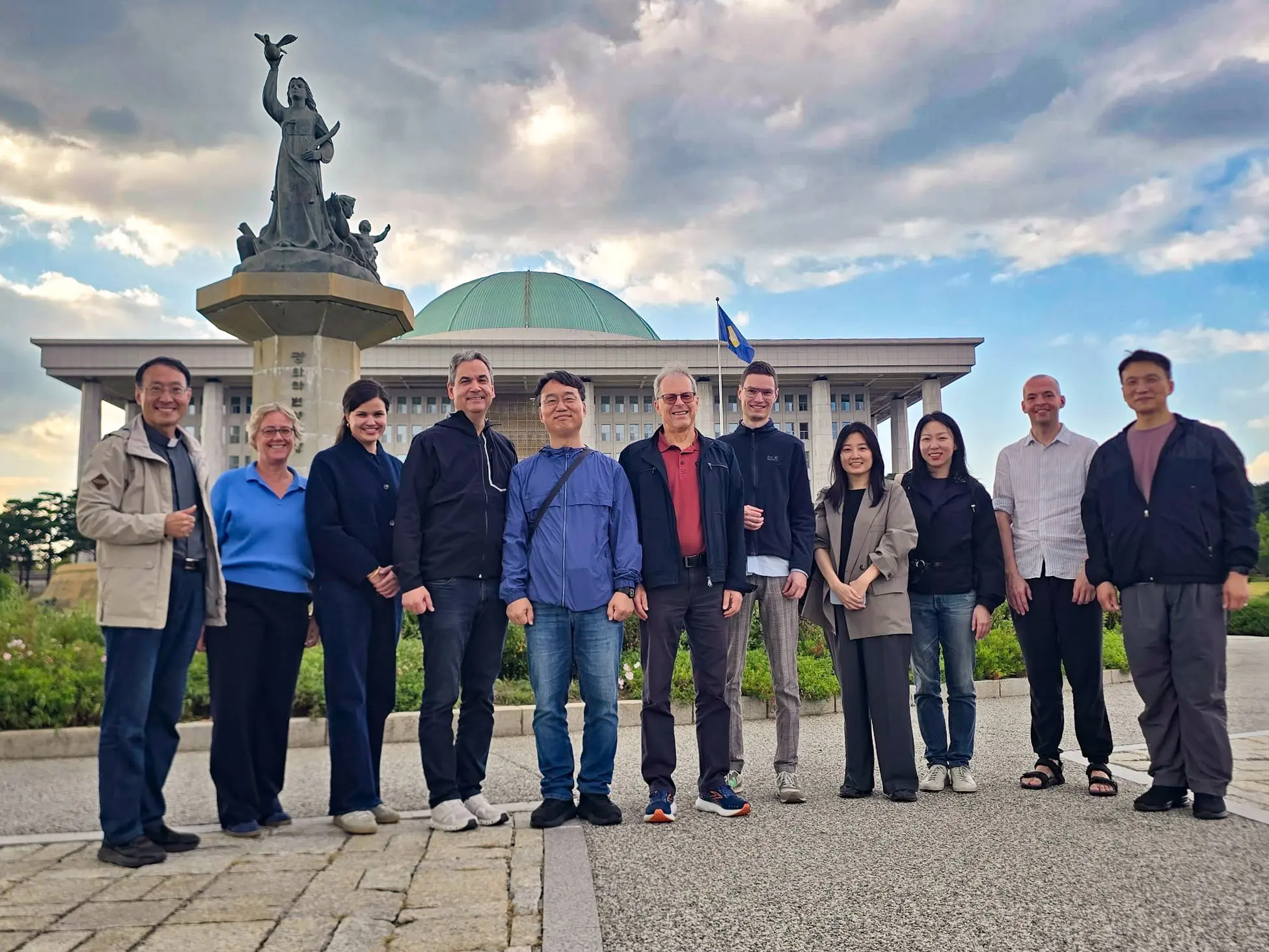
From October 5 to 8, the colloquium at Sogang University brought together experts from Germany and South Korea. The focus was on current challenges facing democratic societies: social polarization, dwindling trust in institutions, and the transformation of political communication through social media. For South Korea, this debate takes on special significance, as issues of democracy, peace, and security there are inextricably linked to the ongoing division of the Korean Peninsula. “It is precisely when comparing different experiences in Politics and Society that it becomes clear that democracy cannot be taken for granted, but rather thrives on exchange, reflection, and responsibility”, says Prof. Dr. Klaus Stüwe, Vice President for International Affairs and Profile Development at the KU. “The German-Korean Colloquium has provided an exceptionally fruitful framework for this for many years.”
Right at the start of the trip, the thematic relevance became tangibly apparent: a field trip took the participants to the Demilitarized Zone on the inter-Korean border. The academic program at Sogang University subsequently brought together diverse disciplinary perspectives from political science, history, theology, sociology, law, and literary studies. The panel discussions focused on democracy and peace, social polarization, religion, and political communication on social media. A central pillar of the colloquium is the direct German-Korean dialog: Each presentation is commented on by a researcher from the other country and then discussed jointly.
The German-Korean Colloquia have a long tradition. Their roots date back to the 1990s. Since 2007, they have been hosted alternately every two years by the KU and Sogang University in Eichstätt and Seoul. The KU has played a key role in shaping this series for many years with its interdisciplinary profile in the humanities, cultural studies, and social sciences, thereby placing significant emphasis on its international engagement. The next German-Korean Colloquium in 2028 will take place in Eichstätt.
On the German side, the conference series is directed by Prof. Dr. Klaus Stüwe; on the Korean side, by Prof. Dr. Seil Oh, Vice President for International Affairs at Sogang University. In addition to Professor Stüwe, this year’s KU delegation included Prof. Dr. Vanessa Conze, Prof. Dr. Ulrich Kropač, PD Dr. Dr. habil. Mariusz Chrostowski, Dr. Sebastian Egelhof, and Laura Gabler. The colloquium was supported by the Professor Sutor Foundation, which made the KU delegation’s trip possible, as well as by the Maximilian Bickhoff Foundation, the KU Faculty of History and Social Sciences, the Hofmühl Brewery, and the Eichstätt University Society.
This long-standing academic exchange regularly results in joint publications. The most recent example is the newly published open-access edited volume “Populism and Post-Truth: Interdisciplinary Perspectives from South Korea and Germany”, edited by Klaus Stüwe and Laura Gabler. The volume brings together papers from the 2024 German-Korean Colloquium in Eichstätt and examines, from various disciplinary perspectives, the consequences for democratic societies when facts lose their significance in political debates.
Text: Laura Gabler , translation: Sylvia Schmager


