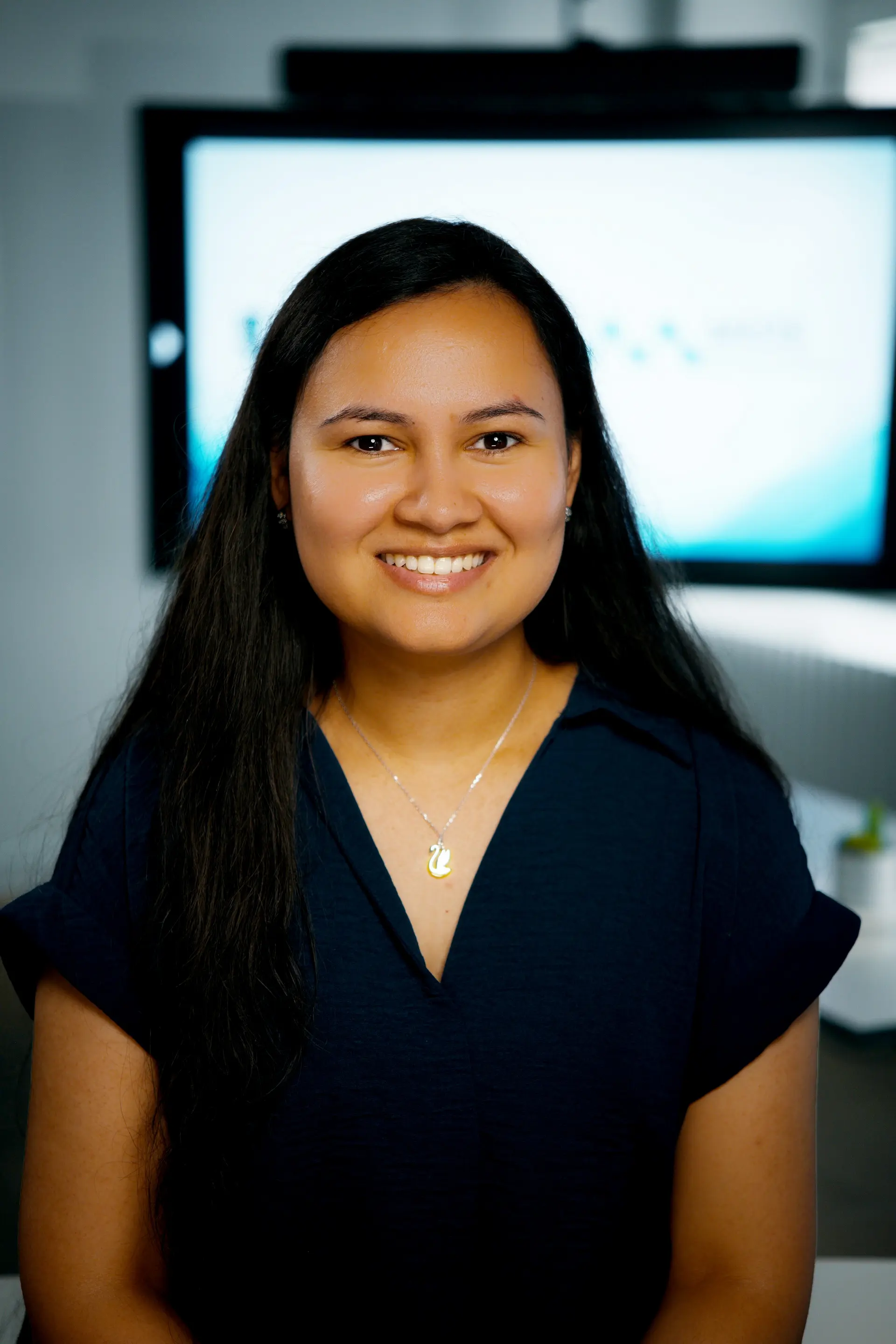
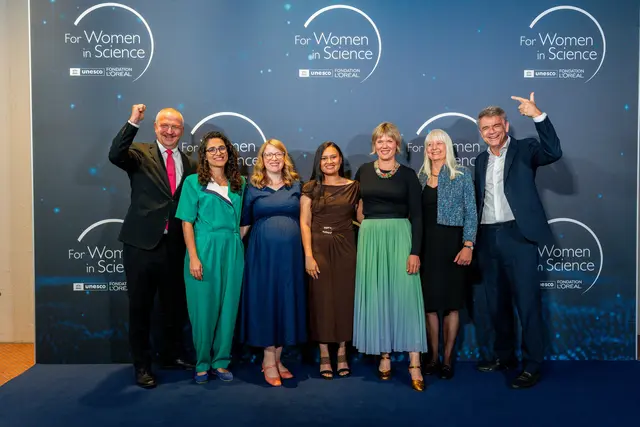
The prize is endowed with 25,000 euros and was awarded to four female researchers this year. The award ceremony took place on Wednesday evening in Düsseldorf. Along with Singh, the award was presented to Dr. Buse Aktaş from the Max Planck Institute for Intelligent Systems in Stuttgart, Dr. Dorit Brixius from the Technical University of Dresden, and Dr. Anna Zieleniewska from the Technical University of Munich’s Straubing campus. The prize is awarded by L’Oréal, the German Commission for UNESCO, and the German Humboldt Network.
KU researcher receives award for research on weather and climate models
![[Translate to English:] Preis für Dr. Mansi Singh](/fileadmin/_processed_/0/b/csm__DSC3483_8dc100f8f6.webp)
Mansi Singh conducts research at the KU Chair of Applied Mathematics held by Prof. Dr. Marcel Oliver, which is part of the Mathematical Institute of Machine Learning and Data Science. Her research, which is embedded in the DFG Collaborative Research Center/Transregio TRR 181, focuses on models of motion in the oceans and the atmosphere. In these systems, fast wave motions overlap with slower currents and vortices. This poses a fundamental problem for computer simulations because, in conventional computational methods, the fast processes can often only be captured using very small time steps. This makes simulations slow and computationally intensive.
Singh is working on mathematical methods to simplify such simulations. Put simply, the computer should not have to calculate every tiny intermediate step individually just because very fast movements also occur in the ocean and atmosphere. Instead, Singh is looking for ways to treat the fast processes separately while preserving the crucial interactions in the model. To do this, she uses methods that identify recurring patterns in complex calculations, thereby reducing the computational effort.
This is relevant to climate and weather research because these fields involve processing large amounts of data and running complex simulations. If such models become more efficient, calculations can be performed faster and with less resource consumption. At the same time, Singh’s work aims to provide a better understanding of how energy is transferred in ocean and atmospheric systems between large-scale currents, waves, and small-scale turbulent movements. Such processes also play a role in modeling weather extremes and long-term climate trends.
Singh has been a postdoctoral researcher at the KU since 2025. She completed her doctoral degree in Mathematics in India in 2024. During her doctoral thesis, she received the Prime Minister’s Research Fellowship from the Indian government.
The “For Women in Science” grant program was launched in 1998 by the L’Oréal Foundation and UNESCO and has been established in Germany since 2007. According to the organizers, more than 4,700 female scientists worldwide have received funding through the program. In Germany, the award has been presented more than 50 times to date. The program is intended not only to promote research but also to draw attention to existing inequalities in the scientific system, said the President of the German Commission for UNESCO, Prof. Dr. Maria Böhmer. “Women are disadvantaged worldwide, including in UNESCO’s fields of work—education, science, culture, and communication,” she explained. UNESCO is working intensively on equal opportunity, equal opportunity, and the removal of barriers. The chairperson of the German Humboldt Network, Prof. Dr. Elke Bogner, also pointed to structural problems: “Equal opportunity and diversity in science are essential for scientific progress.” The “For Women in Science” program sends a strong message to counteract underrepresentation of women in research.
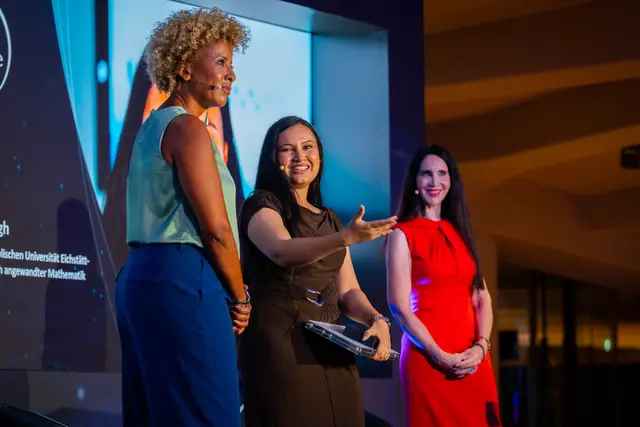
According to the organizers, approximately 150 guests from the worlds of culture, academia, politics, business, and society attended the awards ceremony at the Düsseldorf Schauspielhaus D’Haus. TV host Arabella Kiesbauer led the audience through the ceremony. Among the guests were fashion designer Guido Maria Kretschmer, career mentor and author Christina Sontheim-Leven, and futurist Prof. Anabel Ternès von Hattburg.
Text: Christian Klenk, translation: Sylvia Schmager