More than scarce: The power games over water in Iran
Water is far more than a scarce resource in Iran. It is a political issue, an instrument of power and a central element in the history of the nation state. This is the starting point of Leila Khodabakhsh's dissertation project. The doctoral student at the KU's Human Geography working group is investigating how water policy and power relations are intertwined in Iran.
Under the title "Liquid Realms. Navigating Water, Scale and Power in Iran", she links the topics of water supply, space production and political control and shows how the centralized politics of Iran today shape the lives of every individual. The theoretical framework is provided by political ecology, which investigates a combination of environmental problems with social, economic and political processes. A key concept of the thesis is "scale". "Scale is not something natural, but refers to the social and political production of spatial units," explains Khodabakhsh. It is not about presenting the local level as better than the national level per se. "I want to show how both state centralization and romanticized notions of the local tend to obscure complex interdependencies between local, regional and national levels." To this end, she analyses the production of these scales and how structures have been created over the last 100 years to centrally control access to water – often under the guise of technical efficiency or modernization.
"It is true that there is a water shortage in Iran", says Khodabakhsh. "But that has always been the case in Iran. Water policy could also be adapted to the given framework conditions." Climate change as the cause of worsening water problems is clearly not enough of a justification. The geographer emphasizes: "The problem lies in the distribution and management of water resources, which is driven by financial and political interests." The natural conditions in Iran are not suitable for centralized settlement, which was, however, forced as part of the nationalist orientation of the state in order to have more control. The problem of power is flanked by a problem of corruption: "In Iran, there is often talk of a 'water mafia' – a network that relies on centralization because it can always push through new, lucrative infrastructure projects."
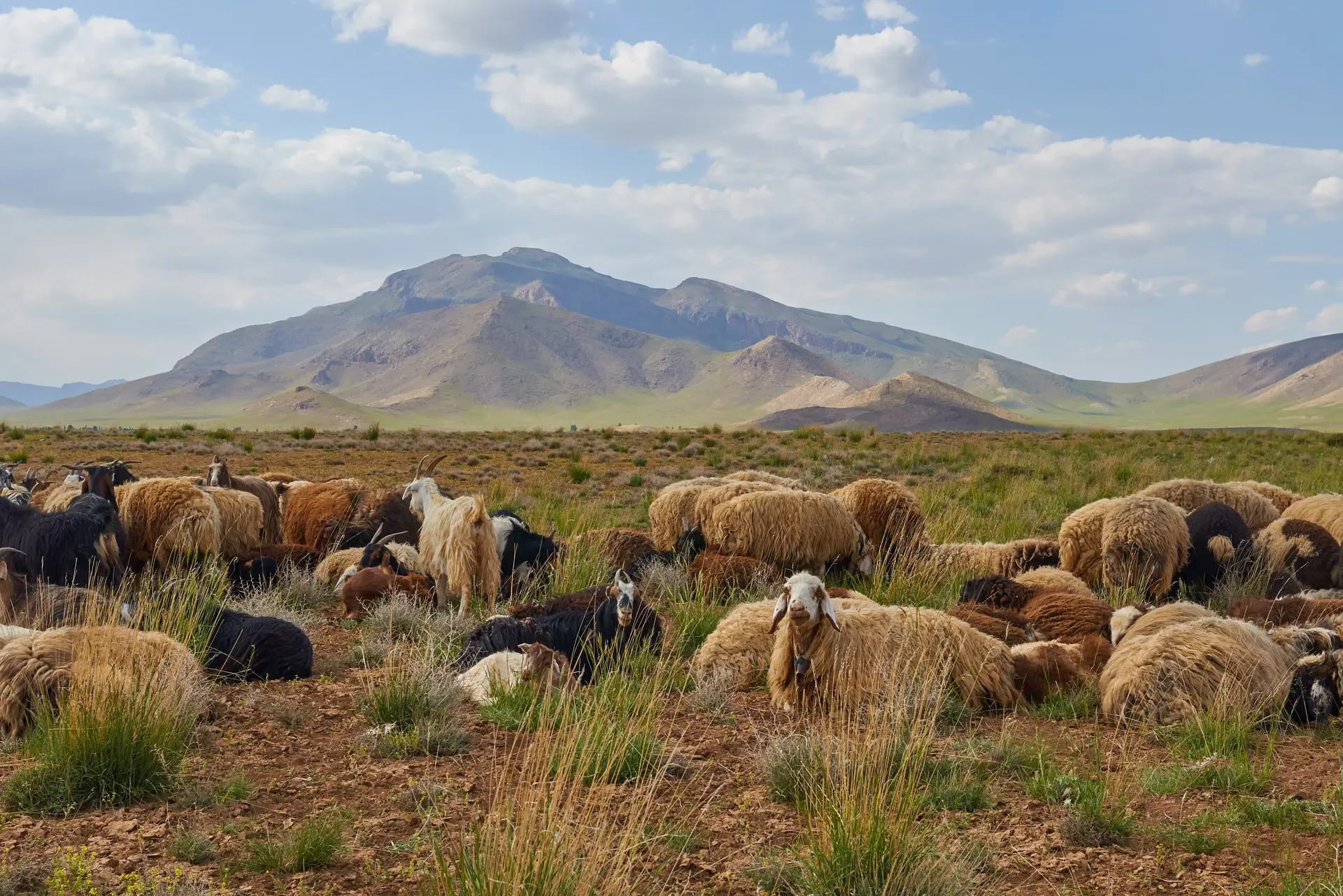
The Zagros Mountains in Iran
Three episodes – one political landscape
The doctoral thesis focuses on three analytical episodes that together represent the water policy landscape in Iran like a kaleidoscope. The first deals with the emergence of the modern nation state and how this created a new political geography of water. "The nation state is the result of a complex interplay of internal and external forces. Notions of space, history and 'race' from National Socialist Germany play a particular role here", explains the researcher. "The understanding of the state is characterized by a maximum demarcation from 'others' and the extensive suppression of internal differences."
Whereas water was previously managed at regional level, the modern nation state relied on centralized control. A linear narrative of progress from backward methods to hydraulic modernity supported the selective forgetting of traditional qanats. This 2000-year-old supply system transports water without energy from sources in the mountains through sloping canals to settlements and towns in the foothills – up to 80 kilometers away. "There were attempts to revive the locally anchored infrastructure of the qanats, but they failed", says Leila Khodabakhsh. She is particularly interested in why such historically grown infrastructures are devalued, while other, technologically much more complex infrastructures are politically charged and preferred.
In the second episode, Khodabakhsh uses an artificial lake in the capital Tehran to show how nationalist ideology is used to legitimize projects that benefit only a few. "At the peak of the water crisis in 2010, the government recreated Lake Chitgar because they wanted a European-style capital", explains the doctoral student. As she shows in her work, the nation state is historically closely linked to the longing for European ideals – even though politicians officially regard the West as an enemy. "This is just the display – at grassroots level there are longings and ideas at work that also existed during the Shah's regime."
In the third episode, Leila Khodabakhsh takes a hopeful look at the present. She focuses on a movement in the Zagros Mountains: After decades, different ethnic and linguistic groups have joined forces to fight against dams and water detour to the detriment of the region. "The activists are united on the water issue and can therefore take a stronger stance towards their goal: returning water management to regional hands."
Leila Khodabakhsh's research interest is rooted in her biography. Born in Tehran, she initially studied architecture in Isfahan. A cultural project in Arkadan, a small town on the edge of the desert, became a key experience for her: "I had created a little paradise for myself, but had to abandon the project because land prices suddenly rose sharply due to supra-regional water transfer projects. That showed me: There is no local paradise in a country where things are fundamentally wrong." Khodabakhsh left architecture behind and studied regional planning in Tehran. She came to the KU as a doctoral student in 2019; her thesis is supervised by Prof. Dr. Christian Steiner. She received funding from the Rosa Luxemburg Foundation for four years and also received support from the KU's scholarship program for young female academics. She is now on the home straight with her thesis.
Her claim to the work is not just of an academic nature. The doctoral candidate wants to convey a differentiated picture of Iran. "Iran is by no means the monolith that it is sometimes portrayed as", emphasizes Leila Khodabakhsh. Rather, the environmental and resource issues it looks at are examples of how complex and contradictory the country actually is. The researcher coined the term "rigid fluidity" for this phenomenon: "What looks stiff and motionless from the outside is very lively and varied on the inside." The country’s society has never stopped being active on a small scale. However, without democratization, these approaches cannot have a broad impact. "The water issue in Iran – just like the women's issue, economic issues and many others – is ultimately a question of democracy and human rights", emphasizes the geographer. The current developments in Iran therefore give her at least cautious hope: "I'm very optimistic during the day, but at night I think: It will not work. I am constantly fluctuating between feelings of hope and despair."



![[Translate to English:] Der künstliche Chitgar-See in der iranischen Hauptstadt Teheran](/fileadmin/_processed_/c/f/csm_Chitgar_See_Teheran_db02b27a58.webp)