


In the runoff election for the Brazilian presidency, incumbent President Lula da Silva pulled off a surprise victory over his challenger, Flávio Bolsonaro. In the first round, Bolsonaro had a clear lead over Lula—a victory for the right-wing challenger, the son of former President and convicted coup plotter Jair Bolsonaro, seemed all but good. Now Lula has closed the gap, thereby breaking the winning streak of right-wing politicians in South America. Did you speak with family and friends in Brazil after election night? How do you perceive the mood in your home country following Lula’s success, and what does the victory of the left mean for democracy in Brazil?
Morgado: Yes, I spoke with some family members and friends. But the truth is that this was such a special election campaign – especially in the runoff and in terms of the significance that digital activism took on during it. Over these three weeks, I’ve gained more than just impressions following the result. I’ve had the experience of building, together with them, albeit from a distance, something like a “digital party.” It was strongly led by our allied grassroots movement, particularly by Congressman André Janones. Until then, this strategy had been greatly underestimated by the left, which had led to the unpleasant surprise in the first round. Thanks to this mobilization and the involvement of so many artists, young students, and even the more moderate voices of the traditional right, people managed to unite against the threat to democracy. Perhaps the most novel aspect of all this is the realization of just how fundamental social media is in this battle of narratives. I believe that Brazil is demonstrating a resilience and strength internally that we have not seen with this intensity since the return to democracy. This stems from how unprecedented this entire election was – from the comeback itself to the fundamental role played by the streets and social networks. Above all, however, this sends a clear message: Brazilians will no longer tolerate fascism. The presence of the state is indispensable for the country’s development, for reducing inequality, for its infrastructure, and for its sovereignty at a decisive moment in History. And in our political development, the Left – but above all the charismatic figure of Lula – is the only force capable of holding this unity together, alongside the vision of a strong state dedicated to our prosperity and the overcoming of our historical inequality. Brazil has raised a banner of hope for the continent, but it has also had the opportunity to confront some of its traumas head-on and with a fighting spirit.
Bolsonaro has already announced that he will not accept his defeat. How do you assess the situation? Will Bolsonaro ultimately concede defeat, or will Bolsonaro’s supporters make Lula’s fourth term of office difficult from the very beginning?
Morgado: Well, there are various ways to interpret this question, and today it seems to me to be the most immediate way to secure the new term of office. First, there is a specific strategy behind this statement. Bolsonarism sustains itself by delegitimizing and discrediting Brazil’s political institutions. It does this to protect its interests – not least in light of the corruption allegations that have long surrounded it – but also to keep this battle of narratives going. The Bolsonaros have already shown, both in politics and in court, that they are incapable of sustaining any project of a collective dream. It is therefore as if their true banner, their constant guiding principle, were always the key to persecution: “The one who fights against the system and suffers for it.” As if the clan’s entire career hadn’t been playing out for years in some of the most opaque backroom deals in Brazilian politics. Second, beyond political survival, this is about the situation of a candidate who knows – especially now that he is losing his parliamentary immunity – that he faces a real prospect of criminal prosecution, just as his father did. It is an act of desperation: He must mobilize the power of his voter base to somehow survive this battle, because the normal course of democracy now means facing justice in court. Several investigations were already underway but were progressing slowly due to his privileged legal status as a senator. Since he also enjoys far less political standing than his father, I believe this move is easier to counter through legal means than it would have been at other times. It is on record that even his own party has called for an extension of the election period. Even the mainstream media are now treating this more as the “speech of a sore loser” than as a clever political maneuver. What will be difficult to manage– as has always been the case since the rise of this extreme right – is their ability to incite very violent behavior among their supporters. Regardless of the outcome, this would be a problem that needs to be solved. This propensity for violence, which is the actual bond between them, is the real problem for Brazil’s social contract. The government must communicate more directly, it must better assess the new labor agenda, and it must engage more intensively with our traumatic, unresolved transitional processes. But all this can only be achieved by a state that demonstrates its presence and makes investments. And that is precisely what all this mobilization seems to point to as the path forward: We must not rest on our laurels after this victory. Aside from all the issues surrounding the economy, sovereignty, and tensions with Congress, it must be clear that we face a societal problem involving resentment and the very possibility of a social pact.
Just two weeks ago, Lula was trailing by about 2 million votes in the polls. In an incredible comeback, he mobilized his supporters by appealing to their fear of a return to authoritarianism and won the election by a margin of about 4.4 million votes. How did he manage to mobilize these voters? What did you observe during the campaign?
Morgado: First of all, I think it’s important to clarify that this was not a case of mobilization through fear as a narrative strategy. The danger was, in fact, real. This is evident in the Bolsonaros’ speeches, in the way they deal with national memory, and in the political, homophobic, misogynistic, and racist violence that their rhetoric incites. That is the driving force, and that is precisely what unites their supporters.
What has changed – and I believe this was mainly due to the surprise in the first round – was the realization that social media shapes a large part of this battle of narratives and that it must not be underestimated. At the same time, the interest of “Big Tech” companies in the electoral process also became clear, as promoting the far right seemed, to a certain extent, to serve their shared interests – above all, the interest in keeping these companies unregulated. The mobilization in this area was absolutely unprecedented for the Brazilian left, and I believe it is already leaving an important legacy of strength and digital activism. Of course, we must not forget the movement in the streets, the engagement of young people, the “Vira-Voto” campaign to change voters’ minds one by one, and the resilience of the voters who weathered such an exhausting election process, both in the weeks leading up to the election and on Election Day itself (the bus boycotts, the canceled flights). For the first time, it seems to be becoming clearer to the left that a confrontation with the far right – without being aware of the betrayal inherent in these alliances with Big Tech, Trump, and the mainstream media – would in fact mean being crushed in every new election. Lula won the runoff by penetrating the Bolsonarists’ strongholds and winning votes precisely where Bolsonaro was strongest. This carries enormous symbolic power and is proof of effective mobilization. It goes down in our history as an opportunity to break the course of Brazilian politics that until now has seemed both natural and abhorrent. The people have granted Lula a new term of office, but above all, they have once again elected themselves as a collective dream.
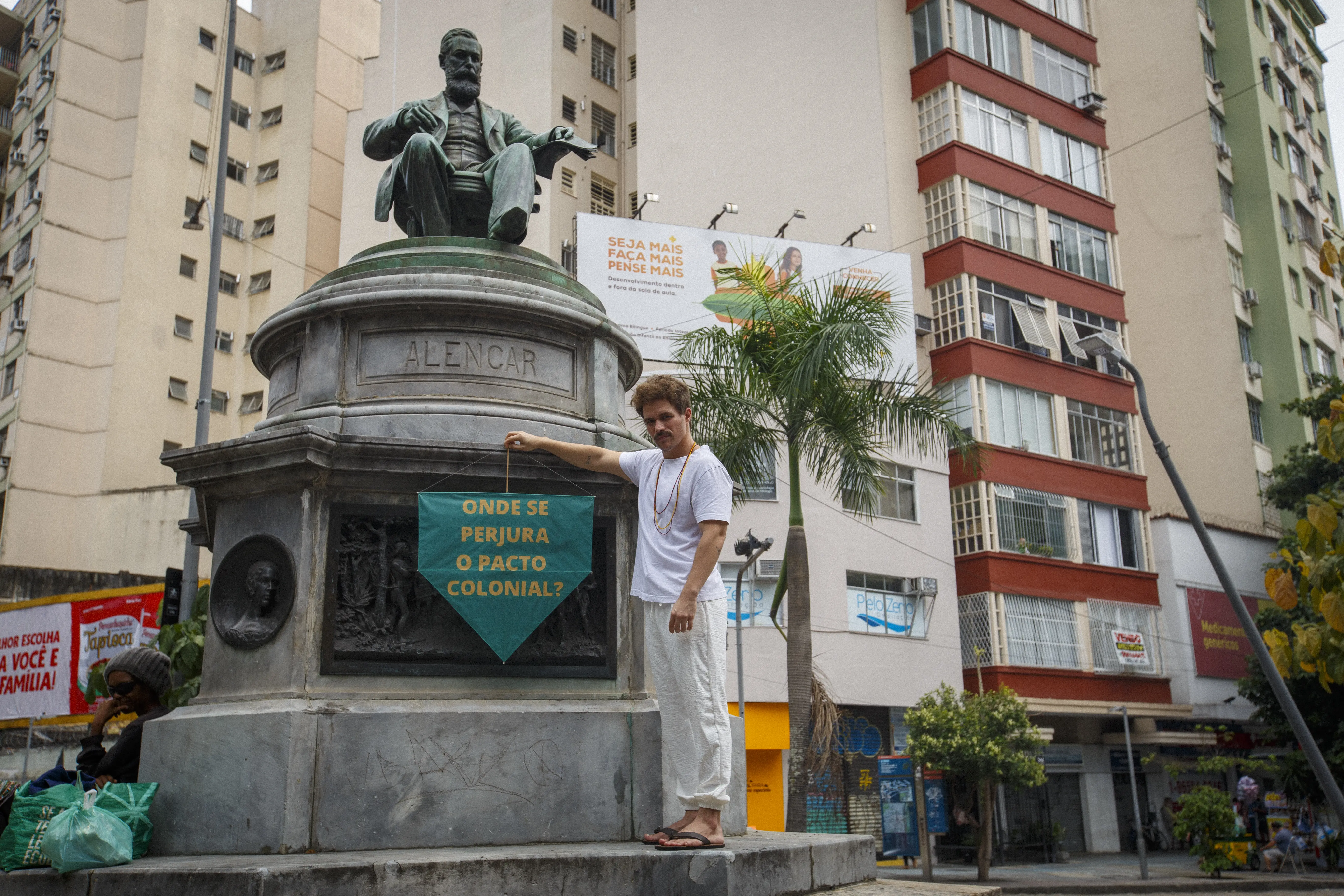
From September 2026 to January 2027, Flávio Morgado, a doctoral candidate in political history at the Universidade do Estado do Rio de Janeiro (UERJ), is on a research fellowship at the Center for Latin American Studies (ZILAS) at the KU. His stay in Eichstätt provided an opportunity to interview him about current events in Brazil.
Interview was conducted by: Melena Renner


