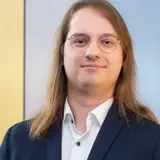
Vladimir
Buskin M.A.
Wissenschaftlicher Mitarbeiter
Raum: UA-212
Postanschrift
Universitätsallee 1
85072 Eichstätt
Universitätsallee 1
85072 Eichstätt
Sprechstunde
Nach Vereinbarung
Nach Vereinbarung
Forschungsinteressen
- Argument realisation and omission in varieties of English
- Usage-based Construction Grammar and cognitive linguistics
- Frame semantics and distributional semantics
- Quantitative corpus linguistics and statistical modelling
- Information-theoretic approaches to language processing
Akademischer Lebenslauf
- 2025–2026: Wissenschaftlicher Mitarbeiter im DFG-Projekt “Constructional Competition – Preposition Stranding and Pied-piping in World Englishes”
- Oktober 2023 – Februar 2024: Lehrbeauftragter am Mathematischen Institut für Maschinelles Lernen und Data Science (an der Juniorprofessur von Prof. Dr. Dominik Stöger; KU Eichstätt-Ingolstadt)
- seit 2023: Doktorand am Lehrstuhl für Englische Sprachwissenschaft (KU Eichstätt-Ingolstadt)
- seit 2021: Wissenschaftlicher Mitarbeiter und Dozent am Lehrstuhl für Englische Sprachwissenschaft (KU Eichstätt-Ingolstadt)
- 2020–2023: M.A. Englische und Deutsche Sprachwissenschaft (KU Eichstätt-Ingolstadt). Titel der Masterarbeit: A Construction Grammar Approach to Null Subjects in Singapore English, Hong Kong English and British English.
- 2019–2020: Studentische Hilfskraft am Lehrstuhl für Englische Sprachwissenschaft (KU Eichstätt-Ingolstadt)
- 2017–2021: B.A. Englische und Deutsche Sprachwissenschaft (KU Eichstätt-Ingolstadt). Titel der Bachelorarbeit: Left- and Right Dislocation in Singapore English: A Corpus-based Analysis.
Kursangebot und Kursmaterialien
- Introduction to English Linguistics (BA)
- English Phonetics and Phonology (BA)
- Language Variation: Varieties of English around the World (BA)
- Language Variation: Empirical Approaches to Varieties of English around the World (BA)
- Statistics for Linguistics (MA)
Kursmaterialien für “Empirical Approaches” und "Statistics for Linguistics" können über mein GitHub repository abgerufen werden.
Workshops
- Buskin, Vladimir, Philippa Adolf and Simon Dampfhofer: “Statistics Workshop“, University of Vienna, Department of Romance Studies (with Ass.-Prof. Albert Wall), 16.–17. Oktober 2024. OSF
Konferenzbeiträge
- “Predicting obligatory and optional semantic roles with word vectors and information theory”. Quantitative Linguistics, University of Tübingen. 26. Juni 2026. [Gastvortrag]
- “Predicting frame element coreness in FrameNet: A machine learning approach”. ICAME47, University of Koblenz. 29. Mai 2026.
- “Is FrameNet usage-based? Predicting frame element types with information-theoretic measures". FJUEL25. Julius-Maximilians-Universität Würzburg. 10.Oktober 2025.
- “A data-driven approach to object omission in English transitive verbs”. ISLE8. Santiago de Compostela, Spanien. 3. September 2025.
- “A quantitative account of the Understood Object Alternation in English". International Argument Alternation Workshop, Kōbe University, Japan. 16. Juli 2025.
- „Modelling ordinal data“, Statistics Workshop, Universität Wien, 17. Oktober 2024. [Gastvortrag]
- “Why can we eat Ø but not *devour Ø? Harnessing NLP and machine learning to explain the Understood Object Alternation”. FJUEL24, Otto-Friedrich-Universität Bamberg. 11. Oktober 2024.
- “Modelling argument omission: A cognitive and multivariate study of object null instantiation in English(es)”. ICAME45, Vigo, Spanien. 19. Juni 2024.
- “Null subjects in Singapore English, Hong Kong English and British English: A Usage-based Construction Grammar Approach”. FJUEL23, FAU Erlangen-Nürnberg. 29. September 2023.
Veröffentlichungen
- with Jakob Horsch. Fixed in English, not (that) free in Slovak: A contrastive study of weight effects. (Under review). [Preprint]
- Buskin, Vladimir. 2026. Modelling object omission availability in English transitive verbs with corpus and psycholinguistic data. Corpus Linguistics and Linguistic Theory. https://doi.org/10.1515/cllt-2025-0004.
- Buskin, Vladimir. 2026. Is FrameNet usage-based? Predicting frame element coreness with information theory and gradient boosting. Language and Cognition 18, e30. 1–31. https://doi.org/10.1017/langcog.2026.10076.
- Buskin, Vladimir. 2025. Definite Null Instantiation in English(es): A Usage-based Construction Grammar approach. Constructions and Frames 17(2). 278–312. https://doi.org/10.1075/cf.24007.bus.