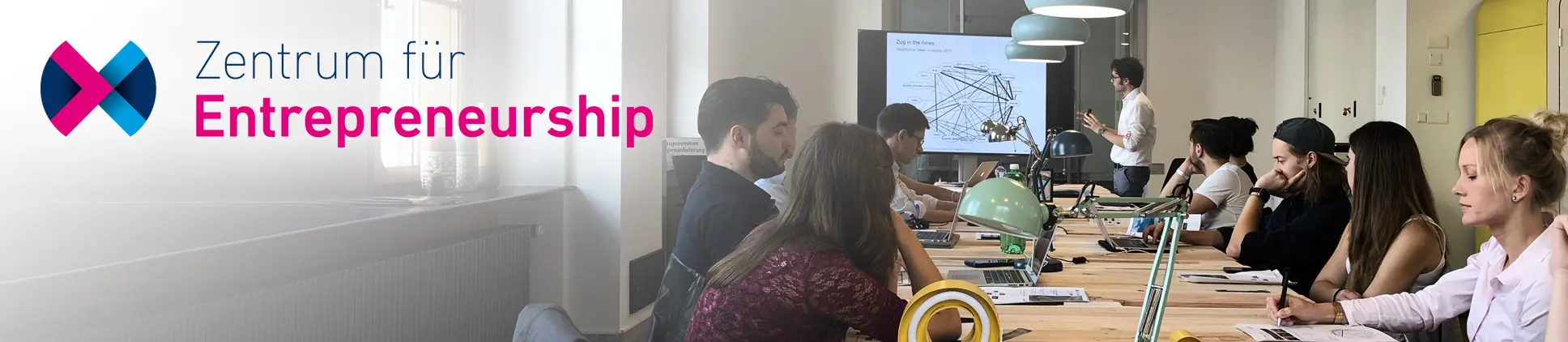
Entrepreneurship interdisziplinär denken und gestalten
Das Zentrum für Entrepreneurship am Lehrstuhl Tourismus befindet sich an der Wirtschaftswissenschaftlichen Fakultät der KU (WFI) am Standort Ingolstadt. Durch seine Verankerung an der Schnittstelle von Wirtschafts- und Geowissenschaften verfolgt das Zentrum einen interdisziplinären Ansatz und verbindet unterschiedliche Perspektiven auf Entrepreneurship.
Im Mittelpunkt stehen Entrepreneurship, Innovation und die Entwicklung neuer Geschäftsmodelle, von der ersten Idee über die Validierung und Weiterentwicklung eines Geschäftsmodells bis hin zu den Herausforderungen bei Aufbau und Entwicklung eines Unternehmens. Dabei versteht das Zentrum Entrepreneurship bewusst branchen- und technologieübergreifend. Unterschiedliche Gründungskontexte, Geschäftsmodelle und Innovationsformen können gleichermaßen Gegenstand von Lehre, Austausch und praxisorientierter Auseinandersetzung sein.
Das Zentrum verbindet wissenschaftliche Perspektiven mit unternehmerischer Praxis. Entrepreneurship wird in der Lehre auf Bachelor- und Masterniveau aufgegriffen und durch anwendungsorientierte Formate ergänzt. Darüber hinaus schafft das Zentrum Möglichkeiten zum Austausch über eigene Gründungsideen und unternehmerische Vorhaben.
Gründungsunterstützung für Studierende
Von der ersten Idee bis zum eigenen Startup entstehen unterschiedliche Fragen und Herausforderungen. Das Zentrum für Entrepreneurship bietet Studierenden der KU eine persönliche Anlaufstelle, um eigene Gründungsideen und unternehmerische Vorhaben zu besprechen und gezielt weiterzuentwickeln.
Die individuelle Begleitung orientiert sich am jeweiligen Entwicklungsstand des Vorhabens. Mögliche Themen reichen von der Bewertung und Konkretisierung einer Geschäftsidee über Zielgruppe, Problem-Solution-Fit und Geschäftsmodell bis hin zu Validierung, Markteintritt und den nächsten Schritten beim Aufbau eines Startups. Dabei können sowohl erste Ideen als auch bereits weiterentwickelte Gründungsprojekte eingebracht werden.
Das Angebot ist bewusst branchen- und technologieoffen und richtet sich an Studierende mit unterschiedlichen Gründungsvorhaben. Im Mittelpunkt stehen die konkrete Situation des jeweiligen Projekts und die Frage, welche nächsten Schritte für dessen Weiterentwicklung sinnvoll sind. Bei spezialisierten Fragestellungen können darüber hinaus passende Ansprechpartner, Netzwerke und weiterführende Unterstützungsangebote identifiziert werden.
Du möchtest eine Idee besprechen oder dein Gründungsvorhaben weiterentwickeln?
Kontaktiere uns unter tourismus-master(at)ku.de!
Nachrichten
Entrepreneurship in Forschung und Lehre
Entrepreneurship in der Lehre
Entrepreneurship und unternehmerisches Denken sind auf unterschiedlichen Ebenen Bestandteil der Lehre am Lehrstuhl Tourismus. Sowohl in Bachelor- als auch in Masterveranstaltungen setzen sich Studierende mit Fragestellungen rund um Unternehmertum, Innovation und die Entwicklung und Veränderung von Geschäftsmodellen auseinander.
Die Lehrangebote verbinden wissenschaftliche Grundlagen mit unterschiedlichen Formen der Anwendung. Neben klassischen universitären Lehrformaten kommen dabei auch interaktive und praxisorientierte Ansätze zum Einsatz.
Ziel ist es, Studierenden nicht nur wissenschaftliche Perspektiven auf Entrepreneurship zu vermitteln, sondern auch das Verständnis für unternehmerische Entscheidungsprozesse, Chancen, Herausforderungen und die praktische Umsetzung von Ideen zu fördern.
Social Entrepreneurship Camp
Der städtische Raum und sein Umland stehen vor lokalen, regionalen und globalen Herausforderungen. Dafür braucht es nachhaltige Lösungsansätze und Ideen! Gemeinsam mit dem sozialen Unternehmen Hilfswerft organisierte der Lehrstuhl Tourismus / Zentrum für Entrepreneurship im November 2022 daher das Social Entrepreneurship Camp, um aus innovativen Ideen nachhaltige Lösungsansätze zu gestalten. Wie die Veranstaltung ablief, erfahren Sie hier.
Lerneinheiten zu Entrepreneurship in Kooperation mit Teejit
Teejit ist ein Eichstätter Startup, das sich auf Weiterbildung im Tourismus in Bereichen wie Nachhaltigkeit, Digitalisierung, Innovation oder Fachkräfte spezialisiert hat. Gegründet wurde es von unserem Absolventen Bastian Hiller zusammen mit Hubertus Stock. Gemeinsam mit ihm haben wir einen digitalen Lernkurs zum Thema "Unternehmensgründung im Tourismus" erstellt, der aus fünf Lerneinheiten besteht:
- Unternehmertum im Tourismus
- Unternehmerische Ökosysteme
- Businessplan und Fördermöglichkeiten
- Krise, Resilienz & Scheitern
- Nachhaltigkeit in touristischen Unternehmen
Weitere Informationen und den vollständigen eLearning-Kurs finden Sie hier.
Wissenschaftlicher Austausch und das G-Forum
Prof. Harald Pechlaner, Leiter des Zentrums für Entrepreneurship, ist Mitglied im Förderkreis Gründerforschung (FGF), der führenden und mitgliederstärksten wissenschaftlichen Vereinigung für Entrepreneurship, Innovation und Mittelstand im deutschsprachigen Raum, sowie Mitglied in deren Gutachterboard. Regelmäßig nehmen Mitglieder des Lehrstuhls Tourismus / Zentrums für Entrepreneurship an der Jahreskonferenz der FGF, der Interdisziplinären Jahreskonferenz zu Entrepreneurship, Innovation und Mittelstand (G-Forum) statt.
2026 wird das G-Forum in Cottbus stattfinden. Die Konferenz 2025 in wurde in Stuttgart abgehalten.
Ein Überblick über die bisherigen Beiträge des Lehrstuhl Tourismus / Zentrum für Entrepreneurship:
2026, Cottbus: AI-Driven Environmental Intelligence for ESG and Biodiversity Transformation - An Empirical Study of the ESA Project TerraLayer.AI in Sustainable Forest Governance
Titel: AI-Driven Environmental Intelligence for ESG and Biodiversity Transformation - An Empirical Study of the ESA Project TerraLayer.AI in Sustainable Forest Governance
Veranstalter: Brandenburgische Technische Universität Cottbus-Senftenberg (BTU)
AutorInnen: Flauger, Philipp; Thees, Hannes
2025, Stuttgart: Beiträge von Silent Voices zur Nachhaltigkeitswende in unternehmerischen Ökosystemen? Drei Fallbeispiele aus der Region Ingolstadt.
Titel: Beiträge von Silent Voices zur Nachhaltigkeitswende in unternehmerischen Ökosystemen? Drei Fallbeispiele aus der Region Ingolstadt.
Veranstalter: Hochschule der Medien Stuttgart (HdM)
AutorInnen: Flauger, Philipp; Bachinger, Monika
2024, Ingolstadt: Impulse von nachhaltigem Unternehmertum für die sozial-ökologische Transformation. Eine fallbasierte Analyse von Einflussgebern, Kontextfaktoren und Wirkpfaden.
Titel: Impulse von nachhaltigem Unternehmertum für die sozial-ökologische Transformation. Eine fallbasierte Analyse von Einflussgebern, Kontextfaktoren und Wirkpfaden.
Veranstalter: Technische Universität Ingolstadt und Katholische Universität Eichstätt-Ingolstadt
AutorInnen: Lana Vizjak, Kerstin Haag, Susanna Bloß, Madlen Schwing, Irene Buller, Monika Bachinger
2023, Darmstadt: Entrepreneurial destination ecosystems: The interplay of tourism and regional entrepreneuship
Titel: Entrepreneurial destination ecosystems: The interplay of tourism and regional entrepreneuship 2023.
2023
Veranstalter: Technische Universität Darmstadt
AutorInnen: Bachinger, Monika ; Schiemann, Julia ; Pechlaner, Harald ; Philipp, Julian ; Schwing, Madlen
2022, Dresden: Entrepreneurial Destination Ecosystems: Inwieweit fördert touristische Aktivität regionales Unternehmertum?
Titel: Entrepreneurial Destination Ecosystems: Inwieweit fördert touristische Aktivität regionales Unternehmertum?
Veranstalter: Technische Universität Dresden
AutorInnen: Julian Philipp, Monika Bachinger, Madlen Schwing, Harald Pechlaner, Julia Schiemann
2020, Karlsruhe (digital): Transformation und Design: Ansätze und Perspektiven für KMUs
Titel: Transformation und Design: Ansätze und Perspektiven für KMUs
Veranstalter: Karlsruher Institut für Technologie KIT
AutorInnen: Greta Erschbamer, Harald Pechlaner, Daria Habicher
2019, Wien: Gemeinwohl und Unternehmensdemokratie - Demokratische Unternehmensstrukturen in gemeinwohlbilanzierten KMUs
Titel: Gemeinwohl und Unternehmensdemokratie - Demokratische Unternehmensstrukturen in gemeinwohlbilanzierten KMUs
Veranstalter: Wirtschaftsuniversität Wien, Österreich
AutorInnen: Elisa Innerhofer, Harald Pechlaner, Daria Habicher, Benedikt Bauer
2018, Stuttgart: Unternehmerische Ökosysteme transformiert: Eine Fallstudienuntersuchung digitaler unternehmerischer Ökosysteme
Titel: Unternehmerische Ökosysteme transformiert: Eine Fallstudienuntersuchung digitaler unternehmerischer Ökosysteme
Veranstalter: Universität Hohenheim / Hochschule der Medien (Stuttgart)
AutorInnen: Harald Pechlaner, Benedikt Bauer, Benedict C. Doepfer, Wolf von Holzschuher
2017, Wuppertal: What is special about Tourism Entrepreneurial Ecosystems?
Titel: What is special about Tourism Entrepreneurial Ecosystems?
Veranstalter: Bergische Universität Wuppertal
AutorInnen: Harald Pechlaner, Monika Bachinger, Ingrid Kofler, Benedikt Bauer
2012, Potsdam: Entrepreneurial effectuation, monocentered markets and regional knowledge networks.
Titel: Entrepreneurial effectuation, monocentered markets and regional knowledge networks.
Veranstalter: Universität Potsdam
AutorInnen: Benedict Doepfer, Stefan Märk, Harald Pechlaner
2011, St. Gallen: Connected dynasties: Social capital in Germany´s high performance family firms and the role for continued pan-generational entrepreneurship.
Titel: Connected dynasties: Social capital in Germany´s high performance family firms and the role for continued pan-generational entrepreneurship.
Veranstalter: Universität St. Gallen, Schweiz
AutorInnen: Marc-Michael Bergfeld, Benedict Doepfer, Ricardo Martinez-Canas
2006, Berlin: Chancen für Unternehmensgründungen durch die Entstehung neuer Branchen.
Titel: Chancen für Unternehmensgründungen durch die Entstehung neuer Branchen.
Veranstalter: Technische Universität Berlin
AutorInnen: Harald Pechlaner, Eva-Maria Hammann, Wolf von Holzschuher
Forschung zu Entrepreneurial Ecosystems
Auch in die Entrepreneurship-Forschung hat der Begriff des Ökosystems (engl. Ecosystem) mittlerweile Einzug gefunden und bildet einen der Forschungsschwerpunkte des Lehrstuhl Tourismus / Zentrum für Entrepreneurship.
Publikationen zu Entrepreneurial Ecosystems
2023: Towards Places and Ecosystems : the Integrated Management of Locations, Destinations, and the Living Space
Titel: Towards Places and Ecosystems : the Integrated Management of Locations, Destinations, and the Living Space
Buch: Considerations of Territorial Planning, Space, and Economic Activity in the Global Economy
Jahr: 2023
Autoren: Julian Philipp, Harald Pechlaner
Abstract: Traditionally, locations, destinations, and living spaces have been managed, developed, and marketed separately. However, various global megatrends such as digitalization, globalization, or climate change—as well as changing needs of workers, tourists, or residents—have put these spatial layers in a state of transformation. In the course of this transformation, integrated spatial development and management concepts have emerged over the past two decades, as modern cities need to manage their neighborhoods and living spaces, business locations, leisure and culture offers, and their tourism attractions holistically. Two main development paths are elaborated: place management, and the ecosystem approach.
2022: The Clash of Entrepreneurial Cultures? Interdisciplinary Perspectives Focusing on Asian and European Ecosystems
Titel: The Clash of Entrepreneurial Cultures? Interdisciplinary Perspectives Focusing on Asian and European Ecosystems
Jahr: 2022
HerausgeberInnen: Harald Pechlaner, Hannes Thees, Wei Manske-Wang
Link: https://link.springer.com/book/10.1007/978-3-030-97050-5
Abstract: This book uncovers the current knowledge on entrepreneurial cultures and the development of entrepreneurial ecosystems between Asia and Europe. Broadening the scope spatially and conceptually, the book discusses the entrepreneurial ecosystems as a system and mediator in their cultural, political, and socio-economic settings in an interdisciplinary approach. This allows a clearer perspective on stakeholders' interaction, international collaboration and competition, power relations, and political influence. The various chapters in this edited volume cover the peculiarities and differences in Asia, Europe, and Eurasia with the New Silk Road (or Belt and Road Initiative) as the bridging component. The chapters, written for researchers and policy makers interested in Asian-European cooperation, also include discussions on economic systems, globalization, and regionalization, politics, cultures, and digitalization.
2022: Entrepreneurial ecosystems in tourism: an analysis of characteristics from a systems perspective.
Titel: Entrepreneurial ecosystems in tourism: An analysis of characteristics from a systems perspective
Journal: European Journal of Tourism Research
Jahr, Ausgabe: 2022, 31
AutorInnen: Monika Bachinger, Ingrid Kofler, Harald Pechlaner
Link: https://ejtr.vumk.eu/index.php/about/article/view/2490
Abstract: This paper transfers the concept of entrepreneurial ecosystems (EEs) to tourism. First it investigates the characteristic of an EE in tourism by comparing it to an existing model. Second, the sector-specificity of the EE in tourism is discussed by referring to the system’s boundaries, operations and purposes, thus linking research on EEs in tourism more strongly to key concepts of systems theory. This is done by evaluating 19 interviews from South Tyrol in a qualitative approach using GABEK (Holistic Processing of Linguistic Complexity), which includes rule-based coding of interviews and visualisation of results in a network graph. Results show that the evaluated EE in tourism shares features familiar to EEs in other business sectors. This is an elevated role of long-standing entrepreneurs, social networks, governance, shared knowledge and learning. However, there are also tourism-specific features, such as culture and landscape, which directly provide resources for entrepreneurship. Governance does not emerge from the interaction of entrepreneurs, but from public bodies. The system’s output is not ambitious entrepreneurship, but innovative, sustainable and collective entrepreneurship. However, there is the need for further research to clearly determine the system’s sector specificity.
2022: Towards an Ecosystem of Hospitality - Location:City:Destination
Titel: Towards an Ecosystem of Hospitality - Location:City:Destination
Jahr: 2022
HerausgeberInnen: Harald Pechlaner, Natalie Olbrich, Julian Philipp, Hannes Thees
Abstract: Derived from the Location:City:Destination conference of 2021, organised by the Chair of Tourism at the Catholic University of Eichstätt-Ingolstadt and Tourismus NRW, a new holistic Ecosystem of Hospitality – an integrated approach to location, destination and the living environment – has been devised to meet the challenges faced by the tourism industry today. Combining scientific papers, case studies and best practice analysis by a variety of contributors, this book seeks to inform and influence academics, researchers, industry professionals and policy makers, presenting a way forward for future development and shared success.
2022: Towards an Ecosystem of Hospitality: The Dynamic Future of Destinations
Titel: Towards an Ecosystem of Hospitality: The Dynamic Future of Destinations
Journal: Sustainability
Jahr, Ausgabe: 2022, 14(2)
AutorInnen: Julian Philipp, Hannes Thees, Natalie Olbrich, Harald Pechlaner
Link: https://www.mdpi.com/2071-1050/14/2/821
Abstract: Digitalization, new work and leisure concepts and global challenges are transforming the way we live. More stakeholders, including residents and entrepreneurs, actively participate in the implementation of alternative socio-economic concepts; as such, entrepreneurial ecosystems are seen as drivers of regional development. The research still lacks holistic approaches to the application of ecosystems in tourism destinations. Hence, the objectives of this article are to capture research on entrepreneurial ecosystems in tourism and, specifically, to derive a holistic model that integrates destination and location management across stakeholders. This research utilizes the method of a systematic literature review, starting with 597 articles on ecosystems. Following four stages of exploring the literature, the results show that most articles have been published in rather isolated fields of smart tourism or quality of life aspects. Based on the rather qualitative review that reveals specific ecosystem components, we propose a model of an “Ecosystem of Hospitality” (EoH). Focusing on stakeholder interaction and encounters, the EoH fosters the adoption of the entrepreneurial ecosystem to destinations in a dynamic approach. The practical implications are, for example, a broader consideration of various stakeholders, including the local population, and a switch in typical destination management tasks from mere tourism service production to regional development and living space management.
2020: Work, life and leisure in an urban ecosystem - co-creating Munich as an Entrepreneurial Destination
Titel: Work, life and leisure in an urban ecosystem - co-creating Munich as an Entrepreneurial Destination
Journal: Journal of Hospitality and Tourism Management
Jahr, Ausgabe: 2020, 44
AutorInnen: Hannes Thees, Daniel Zacher, Christian Eckert
Link: https://www.sciencedirect.com/science/article/abs/pii/S1447677020301637
Abstract: Growing urban areas are facing an increased complexity of coordination and sustainable management whereby the handling of the interests of businesses, residents and tourists demands increased flexibility and openness. Such challenges are partly addressed by the concept of an Entrepreneurial Ecosystem. The idea of an Entrepreneurial Destination also adds the perspective of living and leisure and serves therefore as an overarching concept that defines economic roles and activities by highlighting urban attractiveness and the interplay of the abovementioned stakeholders.
The conducted case study of Munich aims to explore the interconnectedness of work, life and leisure in an urban ecosystem. To do so, 17 semi-structured interviews are processed using the GABEK® method.
Results indicate that residents, entrepreneurs and tourists in Munich benefit greatly from the high attractiveness caused by the interplay and interaction of those groups. Initiatives involving new concepts like coliving, coworking and coexperience have emerged in Munich with the main strength to extended networking and communication of stakeholders.
This paper contributes to open the sector- and stakeholder-specific view and to regard urban development as a multidisciplinary approach, which combines entrepreneurship, changing social life concepts, participation and sustainability of regions.
2020: Sustainable instead of high-growth? Entrepreneurial Ecosystems in Tourism (Special Issue)
Titel: Sustainable instead of high-growth? Entrepreneurial Ecosystems in Tourism
Journal: Journal of Hospitality and Tourism Management (Special Issue)
Jahr, Ausgabe: 2020, 44
AutorInnen: Monika Bachinger, Ingrid Kofler, Harald Pechlaner
Link:
https://www.sciencedirect.com/science/article/abs/pii/S1447677020301716?via%3Dihub
2018: Vom Entrepreneurship Ecosystem zur Entrepreneurial Destination - Perspektiven einer Standortentwicklung am Beispiel der Freizeitszene München
Titel: Vom Entrepreneurship Ecosystem zur Entrepreneurial Destination - Perspektiven einer Standortentwicklung am Beispiel der Freizeitszene München
Buch: Service Business Development. Bd. 2 Methoden - Erlösmodelle - Marketinginstrumente
Jahr: 2018
Autoren: Harald Pechlaner, Hannes Thees, Christian Eckert, Daniel Zacher
Konferenzbeiträge zu Entrepreneurial Ecosystems
2026: Do Incubators and Accelerators Enable Transformation? Social Capital, Start-up Output and Transformation Impact in the European Tourism Sector
Titel: Do Incubators and Accelerators Enable Transformation? Social Capital, Start-up Output and Transformation Impact in the European Tourism Sector
Veranstaltung: 29. Interdisziplinäre Jahreskonferenz zu Entrepreneurship, Innovation und Mittelstand (G-Forum)
Datum, Ort: 16. bis 18. September 2026, Cottbus
AutorInnen: Hannes Thees; Philipp Flauger
2026: AI-Driven Environmental Intelligence for ESG and Biodiversity Transformation - An Empirical Study of the ESA Project TerraLayer.AI in Sustainable Forest Governance
Titel: AI-Driven Environmental Intelligence for ESG and Biodiversity Transformation - An Empirical Study of the ESA Project TerraLayer.AI in Sustainable Forest Governance
Veranstaltung: 29. Interdisziplinäre Jahreskonferenz zu Entrepreneurship, Innovation und Mittelstand (G-Forum)
Datum, Ort: 16. bis 18. September 2026, Cottbus
AutorInnen: Hannes Thees; Philipp Flauger
2025: Beiträge von Silent Voices zur Nachhaltigkeitswende in unternehmerischen Ökosystemen? Drei Fallbeispiele aus der Region Ingolstadt.
Titel: Beiträge von Silent Voices zur Nachhaltigkeitswende in unternehmerischen Ökosystemen? Drei Fallbeispiele aus der Region Ingolstadt.
Veranstaltung: 28. Interdisziplinäre Jahreskonferenz zu Entrepreneurship, Innovation und Mittelstand (G-Forum)
Datum, Ort: 17. – 19. September 2025, Stuttgart
AutorInnen: Philipp Flauger; Monika Bachinger
2024: Impulse von nachhaltigem Unternehmertum für die sozial-ökologische Transformation. Eine fallbasierte Analyse von Einflussgebern, Kontextfaktoren und Wirkpfaden.
Titel: Impulse von nachhaltigem Unternehmertum für die sozial-ökologische Transformation. Eine fallbasierte Analyse von Einflussgebern, Kontextfaktoren und Wirkpfaden.
Veranstaltung: 27. Interdisziplinäre Jahreskonferenz zu Entrepreneurship, Innovation und Mittelstand (G-Forum)
Datum, Ort: 25.-27. September 2024, Ingolstadt
AutorInnen: Lana Vizjak, Kerstin Haag, Susanna Bloß, Madlen Schwing, Irene Buller, Monika Baching
2022: Entrepreneurial Destination Ecosystems: inwieweit fördert touristische Aktivität regionales Unternehmertum?
Titel: Entrepreneurial Destination Ecosystems: inwieweit fördert touristische Aktivität regionales Unternehmertum?
Veranstaltung: 25. Interdisziplinäre Jahreskonferenz zu Entrepreneurship, Innovation und Mittelstand (G-Forum)
Datum, Ort: 21.-23. September 2022, Dresden
AutorInnen: Julian Philipp, Monika Bachinger, Madlen Schwing, Harald Pechlaner, Julia Schiemann
2022: Moving from Traditional Destination Understanding Towards a Holistic 'Ecosystem of Hospitality'
Titel: Moving from Traditional Destination Understanding Towards a Holistic 'Ecosystem of Hospitality'
Veranstaltung: Rethinking Tourism, Hospitality and Events for a Better Future
Datum, Ort: 2.-5. August 2022, Ukulhas, Malediven
Autoren: Harald Pechlaner, Julian Philipp
2022: The Entrepreneurial Destination Ecosystem - On the Pathway to Resilient Destinations
Titel: The Entrepreneurial Destination Ecosystem - On the Pathway to Resilient Destinations
Veranstaltung: 5th Advances in Destination Management Forum (ADM)
Datum, Ort: 8.-10. Juni 2022, Kalmar, Schweden
AutorInnen: Harald Pechlaner, Julian Philipp, Monika Bachinger
2018: Unternehmerische Ökosysteme transformiert: Eine Fallstudienuntersuchung digitaler unternehmerischer Ökosysteme
Titel: Unternehmerische Ökosysteme transformiert: Eine Fallstudienuntersuchung digitaler unternehmerischer Ökosysteme
Veranstaltung: 22. Interdisziplinäre Jahreskonferenz zu Entrepreneurship, Innovation und Mittelstand (G-Forum)
Datum, Ort: 10.-12. Oktober 2018, Stuttgart
AutorInnen: Harald Pechlaner, Benedikt Bauer, Benedict C. Doepfer, Wolf von Holzschuher
2017: What is special about Tourism Entrepreneurial Ecosystems?
Titel: What is special about Tourism Entrepreneurial Ecosystems?
Veranstaltung: 21. Interdisziplinäre Jahreskonferenz zu Entrepreneurship, Innovation und Mittelstand (G-Forum)
Datum, Ort: 4.-6. Oktober 2017, Wuppertal
AutorInnen: Harald Pechlaner, Monika Bachinger, Ingrid Kofler, Benedikt Bauer
Gründungsaktivitäten an der KU
KU-Studierende zeigen ein hohes Maß an Eigeninitiative und unternehmerischem Handeln. So engagieren sich aktuell Studierende in mehr als 43 studentischen Initiativen im nachhaltig-transformativen, kulturell-kreativen oder sozial-karitativen Bereich für eine nachhaltige Entwicklung der Region, neue Beteiligungsformate durch digitale Technologien oder die Integration von Geflüchteten, wie beispielsweise die mit dem Bürgerpreis des Bayerischen Landtags ausgezeichnete Initiative „tun.starthilfe für flüchtlinge“. Mit dem „Institut für Digitales Lernen“ gibt es in Eichstätt zudem ein Beispiel guter Praxis für eine universitätsnahe Ausgründung, welches digitale Lern- und Lehrformate für Schulen entwickelt.
Entrepreneurship an der WFI
An der WFI haben zwei Masterstudierende unter dem Schirm des Alumni-Vereins „IN Kontakt“ und den „WFI-Entrepreneurs“ die „Frankenstein Founders“ gegründet. Ziel ist dabei eine Plattform für die Gründerszene am Standort Ingolstadt zu schaffen, auf welcher man Unterstützung bei Start-Up Projekten bekommt, sowie sich über aktuelle Themen in der Start-Up-Szene austauschen und sich gegenseitig helfen kann.
Die Wirtschaftswissenschaftliche Fakultät der KU am Standort Ingolstadt bietet den speziellen Master of Science Studiengang „Entrepreneurship and Social Innovation“ an. Ziel ist, den Studierenden die Möglichkeit zu eröffnen, unmittelbar an Lösungen für gesellschaftliche Herausforderungen zu arbeiten und dabei zu nachhaltigen Verbesserungen beizutragen. Die Inhalte fokussieren sich auf die Bereiche unternehmerische Innovation, Nachhaltigkeit und ethische Verantwortung sowie deren gesellschaftliche Implikationen und Auswirkungen. Im verpflichtenden, exklusiv an der WFI angebotenen Modul „Social Innovation“ in Kooperation mit der Bayer Cares Foundation wird diese Fokussierung besonders deutlich erkennbar: Hier wird den Studierenden ein möglichst umfangreiches und praxisnahes Wissen in den Bereichen soziale Innovationen und gesellschaftliches Engagement vermittelt. Der Studiengang ist interdisziplinär angelegt, somit sollen Themenfelder neben der betriebswirtschaftlichen auch aus der juristischen und volkswirtschaftlichen Perspektive betrachtet werden. Weitere Impulse bieten Veranstaltungen in den Bereichen Wirtschafts- und Sozialgeschichte sowie Organisationspsychologie.
WFI Entrepreneurs
Die WFI Entrepreneurs wollen in enger Zusammenarbeit mit IN Kontakt Studierende und Absolventen für eine eigene Gründung und eine Karriere im Start-Up Bereich begeistern.
Infromationen gibt es unter www.wfi-entrepreneurs.de