


Ancient Texts, Contemporary Questions: Marievonne Schöttner Appointed Professor of New Testament Studies
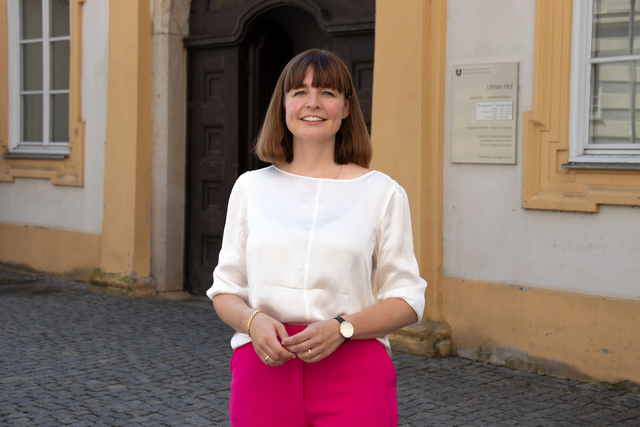
What can texts written 2,000 years ago still convey to people today? For Prof. Dr. Marievonne Schöttner, this question is closely linked to her understanding of academic scholarship. Since April, she holds the Chair of New Testament Studies at the Catholic University of Eichstätt-Ingolstadt (KU). In both her research and teaching, she aims to explore biblical texts within their historical contexts and examine their potential to shed light on contemporary questions.
Marievonne Schöttner took up her professorship at KU at the beginning of the 2026 summer semester. However, she is already well acquainted with the Faculty of Theology in Eichstätt. During the 2025/26 winter semester, she had already served as interim professor of New Testament Studies, and she had previously taught at KU on several occasions as a guest lecturer. “This gave me the opportunity to get to know the students, my colleagues, and Eichstätt,” Schöttner says.
A Milestone in the History of Theology
Born in Bad Homburg, Marievonne Schöttner initially studied German and Catholic religious education for secondary school teaching at the University of Würzburg. In her third semester, she added a diploma programme in Catholic Theology. Although she originally intended to become a teacher, her career aspirations gradually shifted during her studies. After completing her First State Examination and diploma in 2013, she remained at the University of Würzburg as a research associate at the Chair of New Testament Exegesis, where she pursued her doctorate with funding from the German Academic Scholarship Foundation (Studienstiftung des deutschen Volkes).
Following the successful completion of her doctorate in 2017, Schöttner became a programme director at Theologie im Fernkurs, an educational institution in Würzburg that offers distance-learning programmes in theology on behalf of the German Bishops’ Conference. For five years, she supported students, particularly those preparing for careers in parish ministry. Throughout this period, she maintained close ties with academia through teaching assignments, conferences, and her own research. “I increasingly felt that research and teaching were what I was truly passionate about,” she says.
Her subsequent career took her to the University of Bamberg as a research associate and then to the University of Würzburg, where she held an interim professorship, before ultimately bringing her to KU.
With her appointment, Marievonne Schöttner has become the first woman who is not a member of a religious order to hold a chair in New Testament Studies at a Catholic theological faculty in Germany. Her appointment therefore marks a significant milestone in the history of Catholic theology in Germany.
Tracing Hidden Writings from Early Christianity
One of Prof. Dr. Schöttner’s main research interests is the New Testament apocrypha—early Christian writings that were not included in the New Testament canon. She focuses in particular on Coptic texts from the Nag Hammadi library, as well as other early Christian Gnostic writings.
Discovered in Upper Egypt in 1945, the Nag Hammadi codices are among the most significant textual discoveries for the study of early Christianity. Many of the writings, most of which were originally composed in Greek, have survived primarily in Coptic translation. In some cases, both the Greek and Coptic versions are preserved only in fragments, which must be compared and pieced together for scholarly analysis. As Schöttner is proficient in both Greek and Coptic, she can study previously under-researched texts directly in their original languages and gain new insights into the beliefs and intellectual worlds of early Christian communities.
These apocryphal writings shed light on questions that occupied Christians between the second and fourth centuries, including church offices, leadership structures, death, and resurrection. In her award-winning doctoral dissertation, Schöttner examined a central theme in early Christian Gnostic writings: the concept of the “perfect human,” exploring it in texts including the Gospel of Mary and the Gospel of Judas.
The Self-Understanding of Early Christianity
In her current research, Prof. Dr. Marievonne Schöttner examines how Luke narratively portrays the emergence of early Christianity in the Acts of the Apostles and constructs a collective early Christian identity. Luke considers both Judaism and the Greco-Roman world, presenting Christianity as a new religious movement situated between these two spheres.
Schöttner’s research focuses on the elements Luke emphasizes in shaping this identity and on how early Christianity emerges as a collective identity within the narrative world of Acts. In her work, she combines New Testament exegesis with contemporary approaches to identity studies.
At the same time, her project seeks to contribute to the much-debated question of the “Parting of the Ways”—that is, when and how Judaism and Christianity came to separate from one another.
“How Luke does this, through both demarcation and the construction of common ground and continuity, is also fascinating for our own time,” the theologian explains. “I want to explore the connections with interreligious dialogue and social processes of identity formation, and investigate what defines us as Christians today.”
Understanding Biblical Texts in their Historical Context and Rereading them for Today
A cornerstone of Schöttner’s work is her historical-critical approach, which examines the New Testament and apocryphal writings in their historical context. This diachronic methodology is complemented by linguistic and narratological approaches and engages in dialogue with history, literary studies, and the human sciences. At the same time, her approach builds a bridge to the present: “Even today, these writings can provide meaning and offer answers to current social and ecclesiastical debates.”
This perspective also shapes her teaching. Schöttner aims to equip students to engage critically and thoughtfully with biblical texts while exploring the perspectives they offer on contemporary questions of what it means to be human. “Careful methodological work and a clear hermeneutical framework are important to me,” she emphasizes. Above all, she wants to help her students develop the ability to articulate theological ideas confidently: “I want to inspire them and show them how to communicate theological concepts to others in their own words. After all, many of them will later encounter people grappling with existential questions in schools and parishes.”
Alongside her teaching, Marievonne Schöttner is involved in a working group at KU addressing the use of artificial intelligence in teaching and learning. She also seeks opportunities for exchange and collaboration within the academic community and is a member of relevant scholarly associations, including the Society of Biblical Literature and the European Association of Biblical Studies.
Since 2022, she has also served as vice-chairperson of the German section of the European Society of Women in Theological Research. The society has more than 400 members, brings together women scholars from different religious backgrounds, and engages with issues including gender and equality.
Original german text und Photo: Petra Hemmelmann


