AI at KU - Artificial intelligence in university teaching
In November 2022, the American software company Open AI released the chatbot Chat GPT. Shortly afterwards, generative AI tools found their way into learning and education processes. In the years that followed, the development of these so-called LLMs (Large Language Models) progressed rapidly. The number of chatbots and AI-powered image generators has increased exponentially, and the quality of responses has also improved compared to 2022. Nevertheless, many of these chatbots are extremely prone to errors, as an evaluation by European Broadcasting in 2025 revealed. Schools and universities are faced with the challenge of dealing with this still young and rapidly developing technology.
With this website, KU aims to provide its teaching staff with guidance and support. We have compiled frequently asked questions in an FAQ section. An AI certificate helps teaching staff to integrate AI into their teaching in a responsible and beneficial way. We have also developed a guide to working with AI, which we update regularly.
This website is intended to be a living document that will be updated regularly. The coming years will be marked by negotiation processes focused on the responsible use of generative AI tools.
FAQ
Guidance and recommendations for the use of AI.
The KU has published a guide on AI, which you can view here. Individual faculties have also drawn up recommendations. You can obtain information on this from your dean of studies.
What AI tools are available at KU?
You can access the KU's ChatGPT instance at ai.ku.de (on the intranet and via VPN).
At chat-ai.academiccloud.de/chat, you can use free AI models provided by the Society for Scientific Data Processing. To do so, click on "federated login", then select KU from the list and log in with your KU ID.
You can access Microsoft Copilot at copilot.microsoft.com. To do so, you need a Microsoft work account. You can find instructions here: https://www.ku.de/rechenzentrum/it-services/hard-und-software/software/microsoft-office-365. However, according to a study by the European Broadcasting Union, Copilot has significant shortcomings, which is why its use is not recommended.
If you would like to know more, you can find the study here.
I want to ban AI in my teaching. Am I allowed to do that?
Yes, within the framework of the examination regulations applicable at KU, you can decide for yourself which aids are permitted in your course. However, please bear in mind that AI tools are becoming increasingly integrated into students' everyday lives. For example, some word processing programmes already integrate various AI functions (text generation, revision, translation, etc.) into their user interface. Against this backdrop, a strict ban on all AI tools does not appear to be practical. Another problem is proving violations of an AI ban (see previous question).
I would like to change my examination format in view of AI. What do I need to bear in mind?
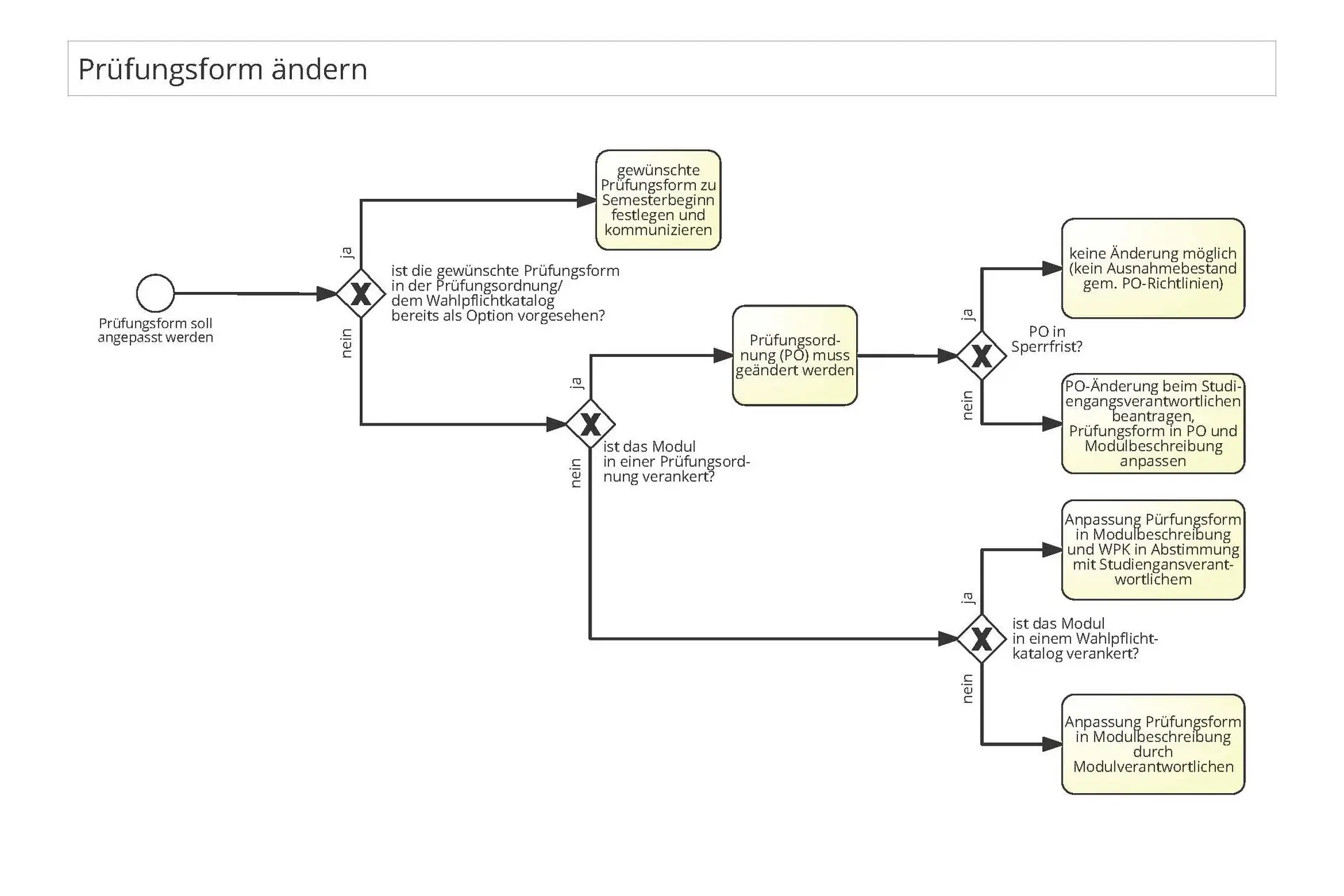
If a form of examination is to be changed, the module description must be amended by the person responsible for the module; the amended module description must be approved by the relevant faculty council. If the module is listed in examination regulations or a compulsory elective catalogue, the examination format must also be adjusted there. These documents are amended in consultation with the programme coordinator and the Quality Management in Studies and Teaching department. If examination regulations have already been amended within the last two years, they are subject to a blocking period for further amendments; in this case, no adjustments can be made.
I suspect that AI was used without permission in exam papers. What can I do?
We strongly advise against using the tools circulating on the internet for detecting AI-generated texts. They all regularly produce false positive results. If you suspect that students have used AI tools without permission, talk to them. It is not legally permissible to fail students on the basis of such suspicions.
For future courses, we recommend (see also Chapter 4 of the AI guide):
- Work with your students to develop rules for the use of AI tools (see the AI guide for more information).
- Clarify whether, in view of technical developments, it is necessary (and possible) to adapt the examination format of your course. For example, shift parts of a written assignment in the form of writing tasks into your course.
- If you have not already done so, introduce a methodology section for written assignments. Here, students can describe and reflect on their use of AI tools (What prompts were entered? How were the text modules evaluated and used? etc.).
- Require your students to disclose the use of AI tools as aids. Also require that appropriate means be used – e.g. in a footnote – to indicate when a text passage has been edited using an AI tool (grammatical improvements/style, translations, etc.).
- If you use declarations of independence, the following sentence could be added: "I confirm that I have fully disclosed the use of AI tools in this work."
Where can I learn more about AI outside of university?
The AI Campus provides self-study courses for anyone interested. The AI Campus is a learning platform that offers online courses, videos and podcasts on the subject of artificial intelligence. The learning resources are free of charge and available under an open licence. The AI Campus is developed and operated by the Stifterverband in collaboration with partners.Bei dem KI-Campus handelt es sich um eine Lernplattform, die Online-Kurse, Videos und Podcasts zum Thema Künstliche Intelligenz anbietet. Die Lernangebote sind kostenfrei und unter einer offenen Lizenz verfügbar. Der KI-Campus wird vom Stifterverband in Zusammenarbeit mit Partnern entwickelt und betrieben.
contact person

Vice President for Studies and Teaching

Inga Maria
Schütte
M.A.
Trainer in higher education learning (focus: digitally enhanced teaching and learning formats)
Room:
KAP 115