![[Translate to English:] Bausteine Leadership](/fileadmin/_processed_/b/7/csm_AdobeStock_519471767_969f2f7522.webp)
Leadership in Transformation (Micro Certificate)
Degree
Certificate
Start of the program
Winter semester
Standard length of the program
1
Semester
Place of study
Blended-learning (ILIAS Platform/Zoom), Georgianum Ingolstadt
Part-time studies possible
No
Leadership in Transformation is an 8-week micro certificate program offered by the School of Transformation and Sustainability (STS). It is designed for leaders who want to act effectively in times of social, environmental, and economic transformation. Using a blended-learning format, the program combines academic reflection with practical leadership skills. The focus is on ethically grounded, transformative leadership approaches and striking a balance between teamwork and strategic action. The program (5 ECTS) fosters exchange between academia and practice – for forward-looking leadership today.
The program in detail
Contents
In the “Leadership in Transformation” micro certificate program, you will develop a motivating vision for your organization and learn how to implement it strategically. You’ll reflect on your own leadership behavior and strengthen your leadership skills in managing change processes. Together with others, you will critically examine theories of leadership, organizational culture, and motivation – and apply them to your professional practice. You will learn how to foster engagement, how to constructively manage crises and conflicts, and how to develop a blueprint for your own transformation project.
Structure
The program consists of eight modules held every two weeks and combines independent study with intensive exchange. The blended-learning format combines asynchronous self-study phases with interactive discussions among participants and with lecturers. Modules 1, 2, 6, and 8 take place as half-day in-person sessions, while modules 3, 4, 5, and 7 are conducted online via the ILIAS platform. This creates a varied and practical learning experience.
Module plan
1. Introduction to Values-Based Leadership
This introductory module focuses on the essential fundamentals of leadership and transformation, as well as the indispensable role of ethics and values in leadership. Participants will become familiar with the core concepts and challenges that shape the modern leadership landscape.
2. Development of Transformation Skills
In the second module, we will focus on the key skills needed to successfully shape and implement change. Participants will learn about the importance and development of a willingness to learn and self-reflect, as well as how to build and strengthen their leadership skills.
3. Vision and Goal Orientation
In the third module, participants deepen their knowledge and skills in the areas of developing a clear corporate vision, setting strategic goals and implementing them, and effectively communicating these elements to the team. This session aims to equip participants with the tools and techniques they need to develop, implement, and communicate a coherent strategy for transforming their organizations.
4. Values as the Foundation for Decision-Making and Digitalization
The fourth module focuses on integrating values into decision-making processes, with a special emphasis on the ethical challenges arising from digital transformation. This module is designed to provide participants with a deep understanding of how crucial ethical behavior and values are to the success and sustainability of transformation processes, particularly in the context of digitalization.
5. Transformation in Organizations
The fifth module focuses on how the theories and concepts discussed previously can be translated into practical implementation strategies. This module aims to equip participants with the skills and tools necessary to successfully plan, initiate, and implement change.
6. Motivation and Inspiration
The sixth module focuses on the crucial role of motivational psychology in leadership practice, as well as on fostering inspiration and creativity during the transformation process. This session is designed to provide participants with the insights and tools necessary to keep teams highly motivated and to create an environment that fosters innovation and creative thinking.
7. Leading Employees and Teams Through Transformation
The seventh module focuses on fostering employee participation and engagement, as well as applying inspiring leadership techniques tailored specifically to the dynamics and needs of teams. This session aims to equip participants with advanced strategies and techniques they can use to create a motivating and inclusive work environment that strengthens team spirit and promotes outstanding results.
8. Conclusion and Transfer to Professional Practice
The concluding module focuses on the presentation of the participants’ individual project work. These projects, which were developed over the course of the program, provide a platform for participants to apply and demonstrate the knowledge and skills they have acquired. In addition, participants work on developing a personal action plan and take part in a feedback and evaluation session for the course.
Rankings and assessments
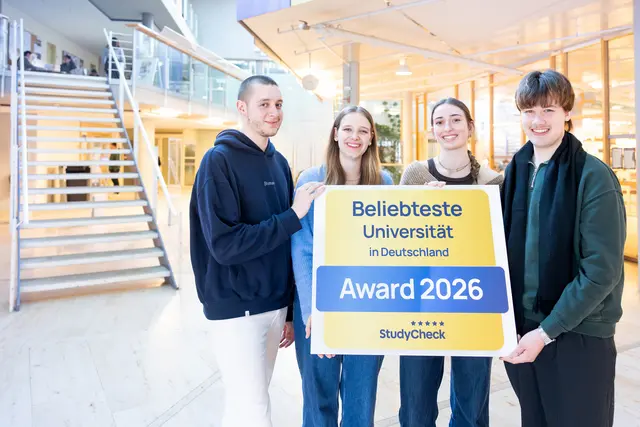
KU students and alumni have voted for their University to be Germany's most popular university in the 2026 ranking of the online portal StudyCheck. This is the fourth time in a row, as KU was also voted the most popular university in 2021, 2022 and 2024. The ranking was based on over 78,000 evaluations for more than 500 higher education institutions and universities. 97 percent of students questioned for the ranking would recommend studying at the KU to others.
"There is no better praise for a university than almost 100 percent of students and alumni agreeing: I can only recommend studying at the KU! That is why we are very pleased with the ranking’s outcome, because it expresses the high level of satisfaction of our students," says KU President Prof. Dr. Gabriele Gien.
Professional practice
The program focuses on your specific practical field: You will develop your own project based on the course content and tailored to your professional challenges. The goal is to design a viable concept for transformative leadership that you can apply directly in your work context.
This gives you the opportunity to immediately translate new insights from theory and exchange into your leadership practice – in a practical, solution-oriented way that ensures sustainable results. Your project becomes a learning space where you can systematically develop and deepen your leadership skills.
Career opportunities and professional fields
The program is designed for individuals in leadership positions who wish to reflect on their existing leadership experience and develop it further in a targeted manner. It offers you the opportunity to strengthen your role as a transformative leader within your company, organization, or institution.
Drawing on new insights from academia and professional practice, you will refine your profile, deepen your skills, and learn to shape change in a strategic, value-driven, and effective manner. In this way, you will make an active contribution to the continued development of your organization – in times of change and beyond.
The KU
Ingolstadt Campus
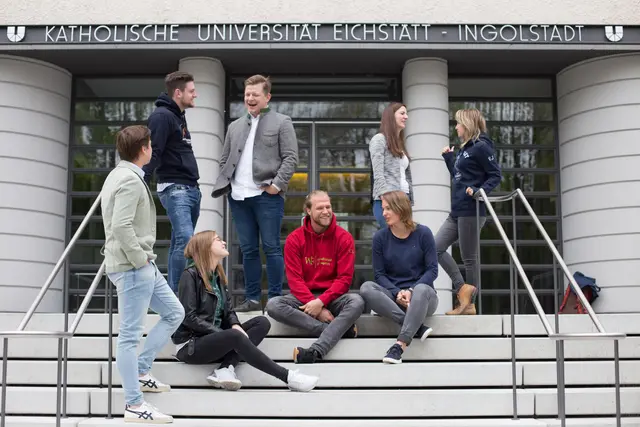
The KU has two campuses: Eichstätt and Ingolstadt. Seven faculties are located in Eichstätt. The Ingolstadt School of Management (WFI) and MIDS (Institute of Applied Mathematics, Machine Learning and Data Science) are located on our Ingolstadt campus.
This degree program is taught on our Ingolstadt campus.
Studying in Ingolstadt
 Study location
The district of Eichstätt and the city of Ingolstadt are located in the heart of Bavaria. This central location also means that the KU is easy to reach. The combination of a historic old town, modern infrastructure, attractive leisure facilities and lots of green spaces makes Ingolstadt – the second largest city in Upper Bavaria – an ideal place to study.
Campus
Despite its central location in the city of Ingolstadt, the WFI campus is characterized by short distances. The KU is a campus University with modern facilities. The buildings on campus are located close to the Ingolstadt old town.
More than just a degree
Studying at the KU not only provides you with the specialist knowledge you need, but also aims to open up real future prospects for its students. We want to support our students in finding their own personal path to their individual dream future! The question is not "What career do I want to pursue?", but rather "Who do I want to be?"
Advisory services
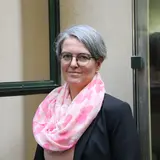
Maria
Müller-Pulsfuß
Counselor for BA Religious Education; Project coordinator and online facilitator JWL
Building
Ulmer Hof
|
Room: UH-009
Some offers and study conditions are different for international students – our International Office is happy to provide help and support. If you have any questions, please feel free to contact our team. We are happy to accompany you on your way to the KU and hope that we can welcome you in person soon!
Enrollment
If you would like to enroll in the micro certificate “Leadership in Transformation”, please follow these steps:
1. Register with the Faculty
Please register by e-mail with the program coordinator, Ms. Maria Müller-Pulsfuß (maria.mueller(at)ku.de), at the School of Transformation and Sustainability (STS). Please state whether you already hold a university degree and/or have relevant professional experience.
Required documents for your application
- Cover letter / Informal registration
- including a brief explanation of your interest in the certificate
- including your contact information, your current organization / employer, and your current position / role within the organization
- Résumé
- in table format (max. 2 pages)
- including details of your professional experience
- Proof of a university degree
(e.g., Bachelor’s, Master’s, or Diplom)
or
a brief description of your professional experience if you do not hold a university degree – in this case, the Continuing Education Committee will conduct an individual suitability review. - Additional proof of qualifications, if applicable
(e.g., continuing education courses, employment references, proof of work experience)
2. Review of admission requirements
The STS will review whether you meet the admission requirements:
- a university degree or
- equivalent professional experience with demonstrated suitability for the program. These criteria are set forth in the program’s bylaws.
3. Welcome letter & enrollment information
If you meet the requirements, you will receive a welcome letter from us. It will include:
- an official confirmation of your admission
- instructions for enrollment at the KU
- a checklist of all required documents
4. Enrollment & payment
- The tuition fee of €950 is paid as part of the enrollment process and already includes the semester fees.
- You enroll online via the KU application portal.
- Upload the welcome letter as an “other document” during the enrollment process, or include it with your signed application for enrollment.
- You can also find all the details regarding enrollment at the KU Student Office.
Requirements
Bachelor
university degree or equivalent - see below
university degree or equivalent - see below
Application period winter
Jul 01
-
Sep 01
Enrollment period winter semester
Sep 02
-
Oct 02
Admission restriction
No
Selection procedure
Yes
Requirements
Proof of a completed university degree or an equivalent qualification obtained through university-level study, as well as at least one year of professional experience. Applicants with professional experience who have demonstrated their suitability for participation in continuing education programs – whether through their profession or by other means – may also be admitted.