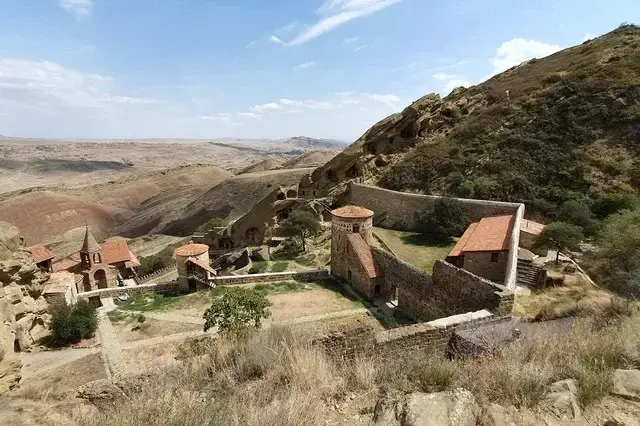
M12: Area Studies & Cultural Heritage
Area Studies is the academic discipline that examines the cultural, social, historical, political, and geographical characteristics of a country or region. It provides contextual orientation knowledge and analyzes how cultural practices, mentalities, and structures emerge and operate within their respective historical and social contexts.
The study of Cultural Heritage requires an interdisciplinary approach that examines tangible and intangible testimonies of human culture in terms of their historical origins, social significance, and contemporary relevance. In this way, processes of preservation, transmission, and transformation of cultural heritage are analyzed, reflecting on their role in identity, memory, and social responsibility.
Regional Studies & Cultural Heritage in the Master's Program MA Eastern Christian Studies
The module M12: Area Studies & Cultural Heritage consists of three learning units:
- M12.1: Countries of the Christian East and their Cultural Heritage (2 ECTS)
- M12.2: Excursion to a Country of the Christian East (1.5 ECTS)
- M12.3: Accompanying Seminar for the Excursion (0.5 ECTS)
The required assessment is a presentation with a portfolio (1 ECTS).
The module comprises a total of 5 ECTS.
Course Content
- Geographical, historical, and cultural foundations of the regions of the Christian East (Middle East, Caucasus, North Africa, India, Eastern Europe, etc.)
- Emergence and development of Eastern Christian cultural landscapes and religious centers
- Archaeological research on Christian sites, churches, monasteries, and settlement structures in the Eastern Mediterranean
- Analysis of significant ecclesiastical and cultural monuments, monasteries, pilgrimage sites, and manuscript collections
- Architecture, art, music, and language as expressions of Eastern Christian identity
- Tangible and intangible cultural heritage: transmission, interpretation, and transformation of religious traditions
- Cultural heritage as a resource for collective memory, religious identity, and intercultural understanding
- Interactions between religion, politics, society, and cultural heritage
- Current challenges: protection and preservation of ecclesiastical cultural assets in the context of war, migration, and globalization
- Ethical and academic responsibility in dealing with religious and cultural heritage
Learning Objectives and Competences
- Students possess in-depth knowledge of the geographical, historical, social, and cultural frameworks of the countries and regions where the Churches of the Christian East originated and operated.
- They understand the interactions between religion, politics, society, and culture in the various epochs and regions of Eastern Christianity (Middle East, Caucasus, North Africa, Eastern Europe, etc.).
- They can analyze central cultural expressions of Eastern Christian traditions—architecture, art, music, language, script, and customs—within their historical and theological contexts.
- They are able to interpret ecclesiastical and cultural monuments, pilgrimage sites, monasteries, and manuscript collections as testimonies of a living cultural heritage.
- They recognize the significance of the tangible and intangible cultural heritage of the Eastern Churches for identity formation, cultural memory, and interreligious dialogue.
- They develop competencies in handling sources, maps, historical documents, and digital resources related to regional studies and heritage conservation.
- They are able to critically reflect on cultural heritage in the context of current challenges—such as globalization, migration, tourism, war, and destruction.
- They can apply approaches from heritage conservation, cultural heritage transmission, and digital documentation (e.g., Heritage Studies, Cultural Mapping, UNESCO cultural heritage concepts) to Eastern Christian contexts.
- They develop an awareness of the ethical and political responsibility involved in dealing with religious cultural heritage.
- They are capable of making academically sound and culturally-historically reflected contributions to the research, preservation, and transmission of Eastern Christian cultural heritage.
M12.1: Countries of the Christian East and their Cultural Heritage
Course Instructor
N. N.
Academic Cycle and Workload
The learning unit is offered every summer semester. It comprises 2 SWS (= 1 ECTS) of digital self-guided learning and approximately the same amount of independent preparation and follow-up time (= 1 ECTS).
M12.2: Excursion to a Country of the Christian East
Course Instructor
N. N.
Academic Cycle and Workload
The learning unit is offered every two years during the lecture-free period between the summer and winter semesters. It comprises a total of 1.5 ECTS.
M12.3: Accompanying Seminar for the Excursion
Course Instructor
N. N.
Academic Cycle and Workload
The learning unit is offered every summer semester. It comprises 1 SWS (= 0.5 ECTS) of synchronous contact study.