![[Translate to English:] Böhlig](/fileadmin/_processed_/f/2/csm_nha_1579_full_7ef2617ef5.webp)
Who Was Alexander Böhlig?
Alexander Böhlig (2 September 1912, Dresden – 25 January 1996, Tübingen) was a German Protestant theologian, Coptologist, and Orientalist and is considered one of the leading figures in the study of Eastern Christianity in the twentieth century. His scholarly work was closely connected with the history, languages, and textual traditions of Oriental Christianity, particularly the Egyptian Christianity of Late Antiquity.
After studying Protestant theology, Egyptology, Semitic studies, and Iranian studies in Berlin, Böhlig received his doctorate in 1934. His academic career initially led him to the Prussian Academy of Sciences before he accepted a professorship in the History of Eastern Christianity at the University of Halle in 1954. In Halle, he taught not only Church History but also languages of Eastern Christianity, including Coptic, Syriac, and Ethiopic, and left a lasting impact on the discipline in both research and teaching.
Alexander Böhlig became internationally renowned above all through his major involvement in the study of the Nag Hammadi codices. From the late 1950s onward, he worked closely in Cairo with Egyptian scholars, especially within the context of the Coptic Museum. His studies, editions, and interpretations of these fourth-century Coptic texts remain among the foundational contributions to the understanding of the religious diversity of early Christian Egypt and of Eastern Christianity as a whole.
After the construction of the Berlin Wall, Böhlig did not return to the GDR in 1963, but instead accepted a professorship at the University of Tübingen. There he established his own department for the languages and cultures of Eastern Christianity, which he directed until his retirement. Even after his retirement, he remained academically active and continued publishing on Coptic literature, Gnosticism, and early Christian theology.
Alexander Böhlig exemplifies a philologically grounded and historically oriented approach to the study of Eastern Christianity, one that sought dialogue between Oriental sources, European scholarly traditions, and international academic cooperation. His scholarly legacy continues to shape Coptology, Church History, and the broader study of Eastern Christianity to this day.
![[Translate to English:] Böhlig](/fileadmin/_processed_/8/8/csm_nha_1395_full_a5e8e1640e.webp)
What Is the Alexander Böhlig Memorial Lecture?
The Alexander Böhlig Memorial Lecture is a regularly held academic lecture event dedicated to the memory of the Coptologist and theologian Alexander Böhlig. Its aim is to bring central topics in the study of Eastern Christianity into public discussion in their historical, theological, and cultural breadth, while at the same time keeping Alexander Böhlig’s scholarly legacy alive.
The memorial lecture focuses on questions relating to the history of Eastern Christianity, its languages and literatures, the early Church, Gnosticism, and the diverse encounters between Christianity, Judaism, and Islam in the Eastern Mediterranean. The invited speakers are distinguished specialists from the fields of theology, church history, religious studies, and Oriental studies. The lecture series is consciously addressed not only to a specialized academic audience, but also to students and to a broader public interested in history and theology.
The Alexander Böhlig Memorial Lecture is made possible through the Gertrud and Alexander Böhlig Foundation. The foundation was established by Gertrud Böhlig in 1999, in memory of and in continuation of the life’s work of the couple, and pursues the goal of sustainably promoting academic research and scholarly exchange in the field of Eastern Christianity.
In particular, the foundation supports projects, events, and initiatives dedicated to the historical-critical study of Oriental Christian traditions and to strengthening international dialogue between the disciplines involved. The memorial lecture reflects this mission of the foundation: it combines academic excellence with public outreach and makes research on Eastern Christianity visible beyond the narrower academic sphere.
The Alexander Böhlig Memorial Lecture thus represents a scholarly attitude that combines philological precision, historical depth, and international openness — entirely in the spirit of its namesake.
Alexander Böhlig Memorial Lectures in Eichstätt
WiSe 2025/26: Dr. Georg Röwekamp: "Christen in der Region Gaza. Eine vergessene Geschichte"
![[Translate to English:] Röwekamp](/fileadmin/_processed_/a/b/csm_IMG_4611.JPG_69ec40d7c7.webp)
On Thursday, 29 January 2026, the Alexander Böhlig Memorial Lecture for the Winter Semester 2025/26 took place in the elegant setting of the Holzer Hall at the Summer Residence. The keynote speaker was Dr. Georg Röwekamp, who delivered a compelling, academically rigorous, and deeply moving lecture entitled "Christians in the Gaza Region: A Forgotten History."
* * *
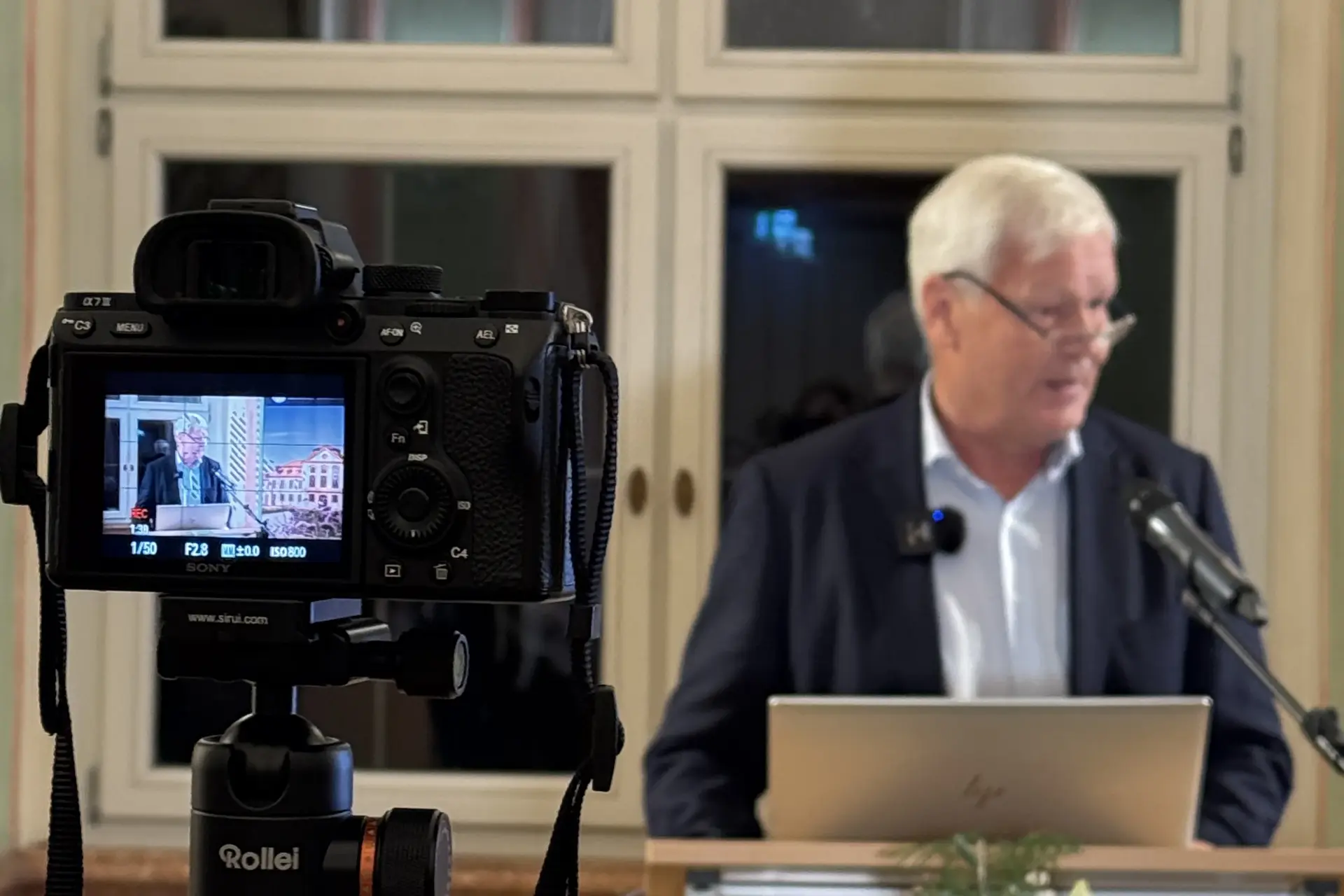
Since the horrific massacre of 7 October 2023, "Gaza" has become synonymous for many people with Islamist terrorism and war. Dr. Röwekamp challenged this one-dimensional perception by offering a nuanced historical perspective. For centuries, Gaza and its surrounding region had been a culturally diverse landscape in which Christianity left a profound and lasting legacy. At various times, the region was an important centre of monasticism, theology, and Christian scholarship.
Drawing on a wide range of historical sources from different periods of Church history, Dr. Röwekamp traced the history of Christianity in Gaza from Late Antiquity to the present day. Particularly moving was his account of the archaeological remains that were still visible before 7 October 2023—churches, monastic ruins, and cultural landscapes bearing witness to nearly two thousand years of Christian presence. He concluded by expressing the hope that not only the Christians of Gaza, who continue to endure extremely difficult humanitarian conditions, but also the material remains of their rich historical heritage, might survive the ongoing conflict.
The lecture attracted considerable interest. The Holzer Hall was filled to capacity, while many additional participants joined the event online via Zoom. The lively discussion that followed explored both historical questions and the current political and humanitarian situation in the region. Conversations continued well into the subsequent reception, reflecting the audience's strong engagement with the topic.
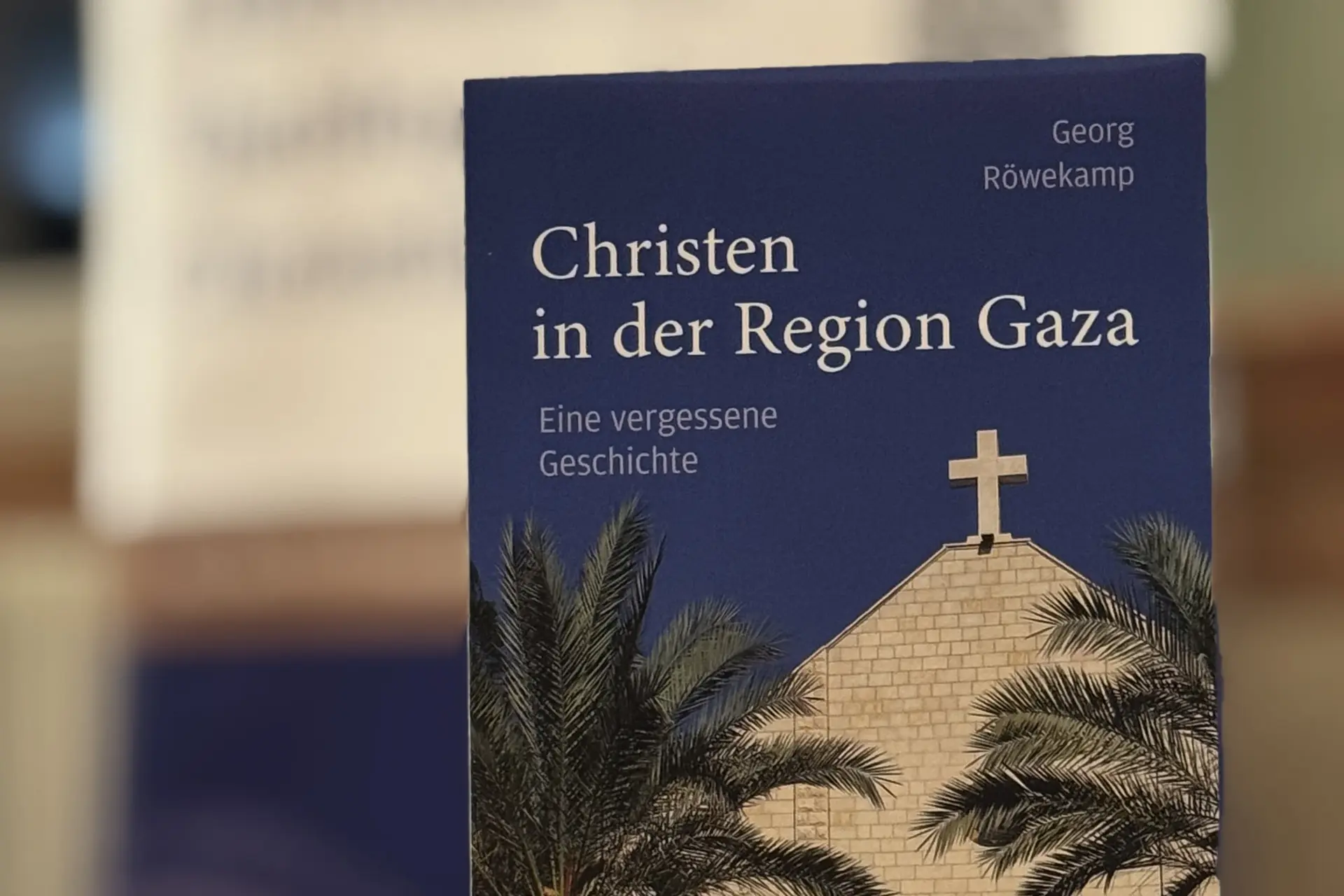
Georg Röwekamp (born 1959 in Duisburg) studied Catholic theology with a specialization in Early Church History in Bonn, Jerusalem (Dormition Abbey), and Bochum. Following several positions in pastoral ministry, he worked as a tour guide, author, and research associate. In 2004, he received his doctorate from the University of Paderborn with a dissertation on the Origenist Controversy. From 1998 to 2016, he served as Director of the Ecumenical Study Group for Biblical Journeys (Ökumenischer Arbeitskreis für Biblische Reisen), before becoming Managing Director of Biblische Reisen GmbH in Stuttgart. From 2016 to 2020, he represented the German Association of the Holy Land (Deutscher Verein vom Heiligen Lande) in Jerusalem, and from 2020 to 2025 he directed the Association's Pilgrim House in Tabgha on the Sea of Galilee. Through his numerous publications, he has established himself as one of the leading experts on Christianity in the Holy Land.
The event was generously supported by the Gertrud and Alexander Böhlig Foundation and underscored the importance of historically informed perspectives, particularly when addressing highly topical and emotionally charged issues.
Download the event poster here!
Text: Joachim Braun
Photos: Yuliia Kolodchyn
SoSe 2026: Dr. Matthias Kopp: "Iraks christliches Erbe. Vom Überleben im Zweistromland"
![[Translate to English:] BöhligVL](/fileadmin/_processed_/e/8/csm_IMG_7325_c2f26813a4.webp)
With a compelling lecture on the history and present-day situation of Christianity in Iraq, the Alexander Böhlig Memorial Lecture continued its tradition of distinguished academic guest lectures in the summer semester of 2026. On Thursday, 11 June 2026, the Chair of Theology of the Christian East welcomed numerous participants to the Jesuit Refectory of the Eichstätt Seminary, while others joined online via Zoom. The keynote speaker was Dr. Matthias Kopp, spokesperson of the German Bishops' Conference and Honorary Professor of Fundamental Theology and Intercultural Communication at the Vinzenz Pallotti University, who delivered a lecture entitled "Iraq's Christian Heritage: Survival in Mesopotamia."
* * *
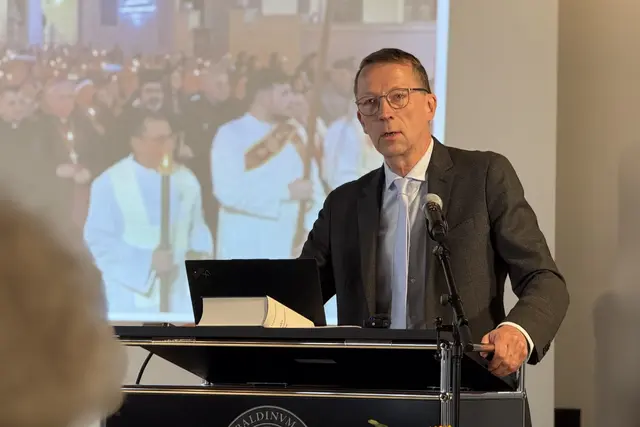
The lecture focused on the remarkably long and eventful history of Christianity in Iraq. Dr. Kopp traced the historical development of Christian communities from their biblical origins to the present day, demonstrating that Mesopotamia ranks among the world's oldest regions shaped by Christianity. As early as the first centuries of the Christian era, Mesopotamia developed into a major centre of Christian theology, liturgy, and scholarship, exerting an influence that extended far beyond the Middle East.
Particular attention was devoted to the profound challenges facing Christians in Iraq today. Decades of political instability, three Gulf Wars, religious tensions, and, above all, the reign of terror imposed by the so-called "Islamic State" have left a lasting impact on Christian life in the region. Numerous historic churches, monasteries, and cultural monuments have been destroyed or severely damaged. At the same time, the continuing emigration of Christian communities has placed nearly two thousand years of religious and cultural tradition at increasing risk. Dr. Kopp emphasized that with every family leaving the country, a part of Iraq's cultural memory is in danger of disappearing as well.
Alongside this analysis of the current situation, the lecture also highlighted efforts toward reconciliation and the preservation of Iraq's Christian heritage. Dr. Kopp discussed the diplomatic and humanitarian engagement of the Holy See, paying particular tribute to the historic Apostolic Journey of Pope Francis to Iraq in 2021. He stressed that this visit represented a powerful sign of hope extending far beyond the Catholic Church and brought international attention to the plight of Iraq's Christian communities. At the same time, he underscored the importance of interreligious dialogue as an indispensable foundation for peaceful coexistence among the country's diverse religious communities.
Throughout the lecture, Dr. Kopp combined scholarly analysis with personal observations and insights gained through his long-standing engagement with the Middle East. In doing so, he succeeded in presenting historical developments, ecclesiastical contexts, and contemporary challenges in a manner that was both accessible and compelling. The discussion following the lecture reflected the audience's strong interest in the complex political, religious, and cultural developments of a region whose Christian heritage is of outstanding significance for the history of global Christianity.
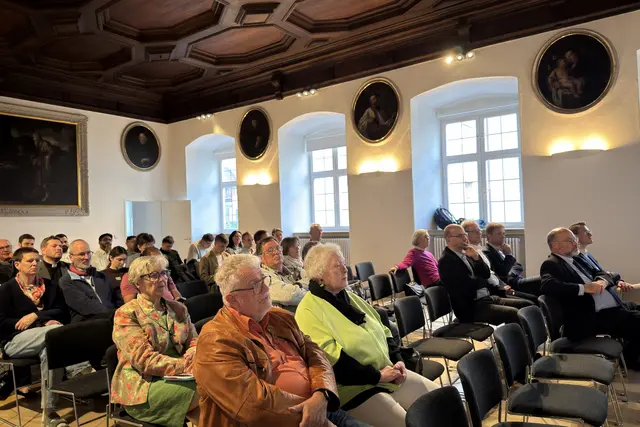
With Dr. Matthias Kopp, the Chair of Theology of the Christian East welcomed a speaker who combines academic expertise with many years of experience in the fields of media, the Church, and international communication. After studying Catholic theology and Christian archaeology in Bonn, Freiburg, and Rome, he began his career as an editor at Vatican Radio. Since 2009, he has served as spokesperson and Head of the Press Office of the German Bishops' Conference. In March 2026, he was appointed Honorary Professor of Fundamental Theology and Intercultural Communication at the Vinzenz Pallotti University. He is also the editor of numerous publications and has served as a Consultor to the Vatican Dicastery for Communication since December 2024.
The event was generously supported by the Gertrud and Alexander Böhlig Foundation. Following the lecture, a reception provided an opportunity for personal exchange between the speaker, students, researchers, and other guests.
Download the event poster here!
Text: Joachim Braun
Photos: Yuliia Kolodchyn