Documenting Old Franciscan Churches in Egypt
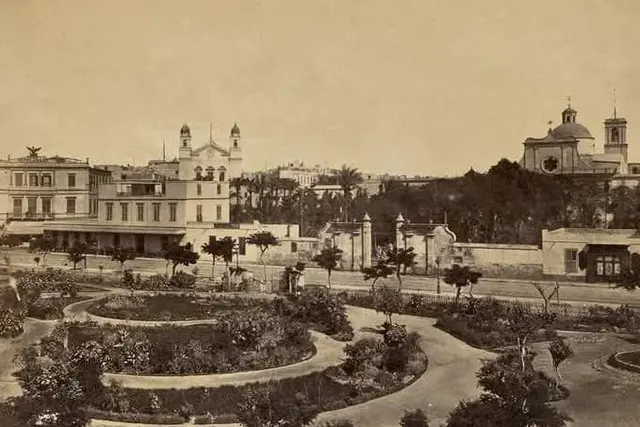
The project “Documenting Old Franciscan Churches in Egypt” is dedicated to the scholarly documentation and digital preservation of Franciscan churches in Egypt. The aim of this long-term undertaking is to preserve the rich religious, cultural, and architectural heritage of Egypt’s Catholic communities while at the same time making it accessible to a broader academic and public audience. The Catholic churches of Egypt constitute an important part of the country’s history and cultural diversity. Over the centuries, a wide variety of traditions, architectural forms of expression, and social networks have emerged, all of which continue to shape the cultural life of the country to this day.
Objectives of the Project
At the center of the project stands the comprehensive documentation of historically significant Catholic church buildings and of their liturgical, artistic, and social contexts. The project seeks to record architectural features as well as historical developments, religious traditions, and the social functions of the respective communities. Particular attention is also given to the diverse cultural interactions that have shaped Egypt’s Catholic churches over the centuries.
![[Translate to English:] Alexandria](/fileadmin/_processed_/e/6/csm_Alexandria_898e614258.webp)
The project explicitly understands itself as a contribution to the preservation of Egypt’s cultural heritage. The churches are regarded not only as religious sites, but also as historical testimonies to social developments and intercultural encounters. Through scholarly documentation, important sources are to be preserved for future research, while at the same time opening new perspectives on the history of Christianity and the Franciscans in the Middle East. Furthermore, the project seeks to contribute to interreligious and social dialogue by strengthening awareness of the role of Catholic communities within Egyptian society.
Methodological Approach
Methodologically, the project combines historical research, fieldwork, and digital documentation. Extensive on-site investigations are planned in various regions of Egypt. Historical churches will be systematically documented through photography, while architectural details, works of art, frescoes, and liturgical furnishings will be recorded. In addition, interviews with clergy, members of local communities, and regional stakeholders are intended to document not only the churches themselves but also the living culture of memory and the social significance of these churches for their respective communities. At the same time, local and international archives will be examined in order to collect historical sources and previously little-known information concerning the history of the individual churches.
![[Translate to English:] Alexandria](/fileadmin/_processed_/6/b/csm_Alexandria_2_ae8747003b.webp)
Significant Church Sites
Among the significant church sites already identified are St. Joseph’s Cathedral in Cairo, the Church of “Our Lady of Mount Carmel” in Bulaq, St. Catherine’s Cathedral in Alexandria, the Sacred Heart Church in Alexandria, the monastery and church in Port Said, as well as the Church of the Stigmatization of St. Francis in Assiut.
Results and Digital Presentation
The project results are intended to be published in various formats and made accessible over the long term. Planned outputs include scholarly studies on the history of Catholic churches in Egypt, digital image and video documentation, virtual presentation formats, and a website through which researchers and the interested public will be able to access the materials. In addition, workshops, educational programs, and public events are planned in order to raise greater public awareness of the cultural heritage of Egypt’s Catholic communities.
Cooperation Partners
The project is jointly carried out by the Centro Culturale Francescano (CCF) in Cairo and the Research Centre for Oriental Christianity at the Catholic University of Eichstätt-Ingolstadt. For this purpose, a corresponding cooperation protocol was signed in March 2026. The implementation of the project is conceived as a long-term undertaking extending until January 2030. Particularly noteworthy is the international and interdisciplinary character of the project, which combines historical research, cultural heritage documentation, digital methods, and international cooperation.
![[Translate to English:] CCF](/fileadmin/_processed_/a/b/csm_Logo_CCF_1a1fc22bcd.webp)
![[Translate to English:] CCF](/fileadmin/_processed_/6/c/csm_Team_e02a24f792.webp)
![[Translate to English:] FSCO](/fileadmin/_processed_/8/6/csm_Logo_FSCO_28ed6ecb57.webp)
Perspectives for Franciscan Cultural Heritage
In the long term, the project also aims to integrate Egypt’s historic Catholic churches more strongly into international cultural heritage processes. Prospectively, the project seeks to establish the foundations for including selected churches, for example within the framework of World Heritage tentative lists or through the recognition of intangible cultural traditions.