


Education for Sustainable Development (ESD) as extension subject for teacher training
Degree
State Examination
Semester fee
88
Euro
Start of the program
Winter and summer semester
Standard length of the program
3
Semester
Place of study
Eichstätt
Part-time studies possible
Yes
Language of instruction
German & English
The extension subject “Education for Sustainable Development (ESD)” equips prospective teachers and professionals to effectively integrate sustainability into schools and classroom settings. Students gain in-depth knowledge of global and local challenges related to sustainable development and learn to apply this insight in a pedagogically reflective manner across various subjects.
The focus is on the so-called Whole School Approach: Sustainability is not merely addressed in the classroom but is understood as a guiding principle for holistic school development. The program combines academic foundations with professional practice – ranging from field trips and project work to the development of students’ own school concepts.
The subject in detail
Contents
The extension subject in Education for Sustainable Development (ESD) for elementary school or secondary schools MIttelschule or Realschule qualifies students to thoroughly plan, implement, and further develop sustainability-related educational processes. You will examine key environmental, social, and economic challenges of our time and reflect on their significance for schools and classroom settings.
During the course, students will acquire:
- In-depth knowledge of concepts and theories of sustainable development
- Deepened insights into the fundamentals and pedagogy of ESD
- Skills for analyzing global and local transformation processes
- Abilities to design sustainability-oriented lesson plans
- Knowledge of school development in the context of a “whole-school approach”
- Practical skills for shaping and fostering sustainability skills in pupils
A particular focus is placed on linking theory and practice: You will develop specific lesson plans and school projects and reflect on their implementation using a scientifically substantiated approach.
Interconnected studies
The degree program has an interdisciplinary focus and integrates perspectives from various academic disciplines as well as diverse research paradigms. This interdisciplinary approach enables a holistic view of complex societal issues.
Through collaborative partnerships, the program also maintains close ties with the Center for Teacher Education (ZLB). This collaboration particularly strengthens the program’s professional orientation and promotes exchange between subject-specific scholarship, subject didactics, and educational practice.
Engaged Learning
The required elective areas give students the opportunity to critically reflect on and purposefully apply the teaching and learning methods they have acquired. Particular emphasis is placed on independent and reflective thinking and responsible action.
The goal of the program is to empower students to become socially responsible educators and subject specialists in the spirit of “change agents.” They are prepared to actively help shape social change processes and to further develop educational processes in a forward-looking manner.
Personalized learning
The program promotes students’ personal development through theory-based and practice-oriented modules. Professional qualifications and personal reflection go hand in hand.
The courses provide space for students to explore their own ideas, attitudes, and perspectives on sustainability-oriented career paths in educational practice, as well as their own professional development.
An intensive mentoring relationship supports individual development. This gives students the opportunity to contribute their personal strengths, further develop them, and refine their own professional profile.


Structure
This extension subject is worth 45 ECTS credits and can typically be completed in 3 semesters as a full-time student (6 semesters as a part-time student). These credits are divided equally among the three areas of study—Foundations, Specialization, and Practice—with 15 ECTS credits allocated to each.
Semester 1 - foundations
The first semester focuses on the theoretical foundations of sustainable development and ESD. You will explore key environmental, social, and economic challenges and become familiar with various disciplinary perspectives on sustainability. In addition, you will acquire fundamental pedagogical knowledge to effectively teach ESD to students in both school and extracurricular settings. A field trip to selected learning sites complements the theoretical content with practical insights and initial experiences with specific examples for implementation.
Semester 2 - specialization
In the second semester, you will deepen your knowledge of subject-specific and subject-didactic approaches to ESD and school development.
In addition, you will select courses totaling 9 ECTS credits from a wide range of specialization and elective options. This will give you the opportunity to set individual priorities and further develop your personal profile in the field of ESD.
Semester 3 - practice
The third semester is strongly practice-oriented. The focus is on specific examples of sustainable school development and project-based courses.
In addition to preparing for the State Examination, you will earn an additional 5 ECTS credits from the required elective area during this study phase. You will independently plan, test, and reflect on sustainability-related projects, thereby specifically strengthening your ability to design and implement initiatives for sustainable regional development.
The program concludes with the development of a clear, individual specialization in the field of education for sustainable development and equips you to integrate sustainability into schools and classrooms in a competent, thoughtful, and effective manner.


Rankings and assessments
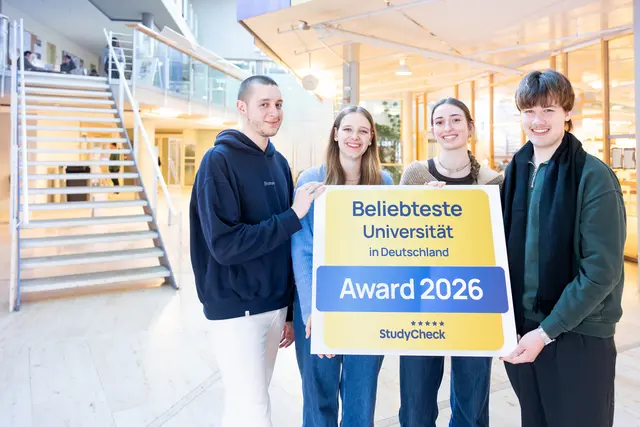
KU students and alumni have voted for their University to be Germany's most popular university in the 2026 ranking of the online portal StudyCheck. This is the fourth time in a row, as KU was also voted the most popular university in 2021, 2022 and 2024. The ranking was based on over 78,000 evaluations for more than 500 higher education institutions and universities. 97 percent of students questioned for the ranking would recommend studying at the KU to others.
"There is no better praise for a university than almost 100 percent of students and alumni agreeing: I can only recommend studying at the KU! That is why we are very pleased with the ranking’s outcome, because it expresses the high level of satisfaction of our students," says KU President Prof. Dr. Gabriele Gien.
Studying abroad
As part of the teaching degree program, there are a variety of opportunities to integrate a study stay abroad (e.g., Erasmus+, a semester abroad, or international internships). The KU International Office is happy to support and provide advice on planning and financing.
In addition, many courses address global issues related to sustainable development and incorporate international perspectives as well as current research projects.
Practical connection
The practical component of this extension subject is closely linked to specific applications in both school and extracurricular settings. In addition to project-based seminars, field trips, and school-related development modules, the courses maintain a consistent focus on practical application. You will work with real-world case studies, analyze best-practice approaches to sustainable school development, and develop your own project ideas for classroom instruction and school-wide initiatives.
In the required elective area, you will independently implement a sustainability-related project and reflect on it in a scientifically sound manner. In doing so, you will benefit from existing partnerships and networks in the field of ESD.
Career opportunities and professional fields
Career opportunities
Sustainability has long been a central topic in school quality development and educational policy programs. With this elective, students will gain a forward-looking additional profile that is increasingly in demand in the school context.
As a teacher with the ESD extension subject, students can:
- Initiate and coordinate sustainability processes in schools
- Design school development projects based on a “whole-school approach”
- Integrate ESD concepts across disciplines
- Serve as director of environmental and sustainability projects
- Serve as a contact for sustainability at their school
In addition, the profile they acquire opens up opportunities for collaboration with extracurricular educational stakeholders, associations, or initiatives in the field of sustainable development.
By combining their teaching degree program with the ESD specialization, they will develop a unique professional profile that distinguishes them as a committed and forward-thinking teacher.
The KU
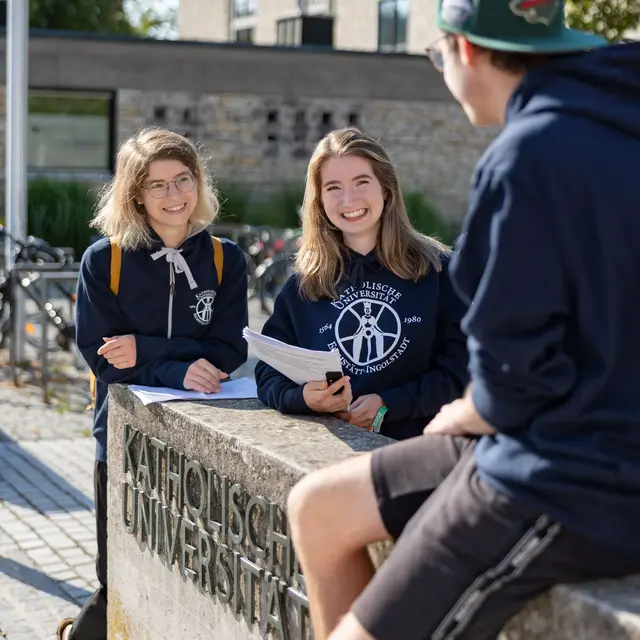
The KU has two campuses: Eichstätt and Ingolstadt. Seven faculties are located in Eichstätt. The Ingolstadt School of Management (WFI) and MIDS (Institute of Applied Mathematics, Machine Learning and Data Science) are located on our Ingolstadt campus.
This degree program is taught on our Eichstätt campus.
Studying in Eichstätt
 Study location
The district of Eichstätt and the city of Ingolstadt are located in the heart of Bavaria. This central location also means that the KU is easy to reach. Eichstätt impresses with its unique combination of baroque architecture, modern amenities and the picturesque nature of the Altmühltal natural park.
Campus
Short distances and lavish green spaces characterize the KU campus in Eichstätt. The KU is a campus University with modern facilities. The buildings on campus are located close to the Eichstätt old town.
More than just a degree
Studying at the KU not only provides you with the specialist knowledge you need, but also aims to open up real future prospects for its students. We want to support our students in finding their own personal path to their individual dream future! The question is not "What career do I want to pursue?", but rather "Who do I want to be?"
Advice and support
Subject advisors
If you have any specific questions about this program, the team at the Professorship of Geography Education and Education for Sustainable Development is here to help. Please feel free to contact the subject advisors directly at: studienberatung-bne(at)ku.de

Prof. Dr.
Jan
Hiller
Professorship of Didactics of Geography and Education for Sustainable Development
Room: PPJ-205a
Head of program
Prof. Dr.
Jan
Hiller
Professorship of Didactics of Geography and Education for Sustainable Development
Room: PPJ-205a
Some offers and study conditions are different for international students – our International Office is happy to provide help and support. If you have any questions, please feel free to contact our team. We are happy to accompany you on your way to the KU and hope that we can welcome you in person soon!
Armelle
Langenwald
International degree seeking students coordinator - Campus Ingolstadt
Building
Hauptbau
|
Room: HB-209

Alice
Rohn
International degree seeking students coordinator - Campus Eichstätt
Building
Domplatz 8
|
Room: DP8-203 | Campus Eichstätt
Application
Requirements
General university entrance qualification (Allgemeine Hochschulreife)
see below!
see below!
Enrollment period winter semester
Aug 10
-
Oct 02
Enrollment period summer semester
Mar 20
-
Apr 02
Admission restriction
No
Selection procedure
No
Admission requirements
- Teaching degree program at the KU (undergraduate track; admission no earlier than the 3rd semester)
- Successful completion of the second State Examination for teaching at public schools (retroactive track)
Application
The application process for international applicants is now completely digital. You can register online in our application portal and carry out and submit your application. After you have carried out the application and uploaded your documents, you do not need to send your documents to us again by post. You do have to submit certified true copies only if you are admitted at the time of enrollment.
Depending on the course of study, you may be asked for information on internships, professional experience, etc. Please upload the relevant documents in the upload area for all the information you provide, even if these are not mandatory fields!
Before you start the application process, please read the additional information on this page, in particular the information on the respective (German) language requirements and university entrance qualifications.
Application for international prospective students
Please note that the study requirements, deadlines and application processes for international prospective students are often different. Information for international applicants and applicants who completed their school-leaving certificate or qualifying degree outside Germany can be found here:


