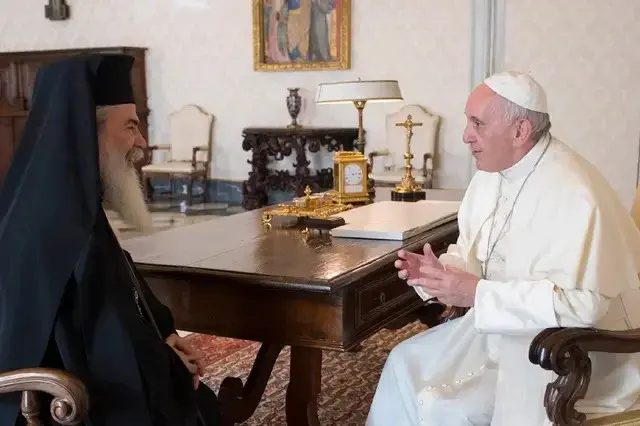
M6: Denominational Studies & Ecumenical Theology
Denominational Studies is the theological discipline concerned with the various Christian denominations. It examines their historical development, doctrines, liturgical practices, forms of piety, and ecclesiastical structures, presenting them in a systematic and comparative manner. The goal is to promote a deeper understanding of the distinct characteristics, commonalities, and differences between churches, thereby contributing to ecumenical dialogue.
Ecumenical Theology is a field of theology that deals with the relationship between the different Christian churches and denominations. It reflects theologically on unity and division within Christianity, analyzes theological differences as well as shared foundations, and promotes dialogue between the churches. The aim of Ecumenical Theology is to foster the visible unity of Christians without leveling denominational diversity, and to identify paths toward deeper mutual understanding and cooperation in theology, liturgy, and practice.
Denominational Studies & Ecumenical Theology in the Master’s Program MA Eastern Christian Studies
The module M6: Denominational Studies & Ecumenical Theology consists of three learning units:
- M6.1: Denominational Studies of the Christian East (1 ECTS)
- M6.2: [Placeholder] (1 ECTS)
- M6.3: Spring School: [Placeholder] (2 ECTS)
The required assessment is a presentation with a term paper (1 ECTS).
The module comprises a total of 5 ECTS.
Course Content
- History and theological foundations of Eastern Christian denominations (Oriental Orthodox, Orthodox, Eastern Catholic/united with Rome)
- Ecclesiological, dogmatic, and liturgical profiles of the Orthodox, Oriental Orthodox, and Eastern Catholic Churches
- Emergence and development of denominational identities in a historical context
- Analysis of key differences and commonalities in theology, liturgy, canon law, and spirituality
- Main currents and documents of the ecumenical movement in the 20th and 21st centuries
- Bilateral and multilateral dialogues (Orthodox – Catholic, Oriental Orthodox – Catholic, etc.)
- Methodological and hermeneutical approaches of ecumenical theology
- Relationship between theology, culture, and politics in an ecumenical context
- Current ecumenical challenges and perspectives in the Christian East
- Significance of interdenominational dialogue for contemporary ecclesiastical and societal issues
Learning Objectives and Competences
- Students possess in-depth knowledge of the ecclesiastical and theological identities of the various Eastern Christian traditions (Orthodox, Oriental Orthodox, Eastern Catholic Churches united with Rome).
- They understand the historical, theological, and cultural prerequisites from which today's denominational structures and self-understandings have developed.
- They are able to compare central dogmatic, liturgical, and ecclesiological positions of the various Churches of the East and analyze their mutual relationships.
- They are familiar with the decisive documents and dialogues of the ecumenical movement (especially Orthodox–Catholic, Oriental Orthodox–Catholic) and can critically contextualize their content.
- They recognize the significance of theological, historical, and cultural factors for ecumenical understanding processes.
- They are capable of presenting denominational viewpoints in a nuanced manner and communicating them in a theologically responsible way.
- They apply scientific methods of historical, systematic-theological, and ecumenical analysis to texts, documents, and ecclesiastical developments.
- They can reflect on current questions of church unity, the understanding of sacraments, ministerial and church structures, as well as theological language from an Eastern Christian perspective.
- They develop sensitivity to the cultural, spiritual, and pastoral dimensions of interdenominational encounter.
- They are able to integrate the results of ecumenical theology into their own theological, academic, or ecclesiastical contexts.
- They work independently with primary sources (e.g., synodal documents, dialogue texts) and relevant research literature, presenting their findings in a precise and argumentatively sound manner.
M6.1: Denominational Studies of the Christian East
Course Instructor
Dipl.-Theol. Joachim Braun
Scientific Coordinator and Manager des Eastern Christian Studies Online Campus
Catholic University of Eichstätt-Ingolstadt
![[Translate to English:] Braun](/fileadmin/_processed_/1/8/csm_Joachim_Braun_38d6078e58.webp)

I am pleased to accompany you through the learning unit on the Denominational Studies of the Christian East. Together, we will embark on an exploration of the fascinating and sometimes confusing world of the Eastern Churches. In the process, we will encounter the spiritual treasures of a vibrant denominational diversity.
I am pleased to accompany you through the learning unit on the Denominational Studies of the Christian East. Together, we will embark on an exploration of the fascinating and sometimes confusing world of the Eastern Churches. In the process, we will encounter the spiritual treasures of a vibrant denominational diversity.
Academic Cycle and Workload
The learning unit is offered every winter semester. It comprises 1 SWS (= 0.5 ECTS) of digital self-guided learning and approximately the same amount of independent preparation and follow-up time (= 0.5 ECTS).
M6.2: [Placeholder]
Course Instructor
N. N.
Academic Cycle and Workload
The learning unit is offered every winter semester. It comprises 1 SWS (= 0.5 ECTS) of digital self-guided learning and approximately the same amount of independent preparation and follow-up time (= 0.5 ECTS).
M6.3: [Placeholder Spring School]
Course Instructor
N. N.
Academic Cycle and Workload
The learning unit is offered every two years as a Spring School during the lecture-free period between the winter and summer semesters. It comprises 2 SWS (= 1 ECTS) of synchronous contact studies and approximately the same amount of independent preparation and follow-up time (= 1 ECTS).